


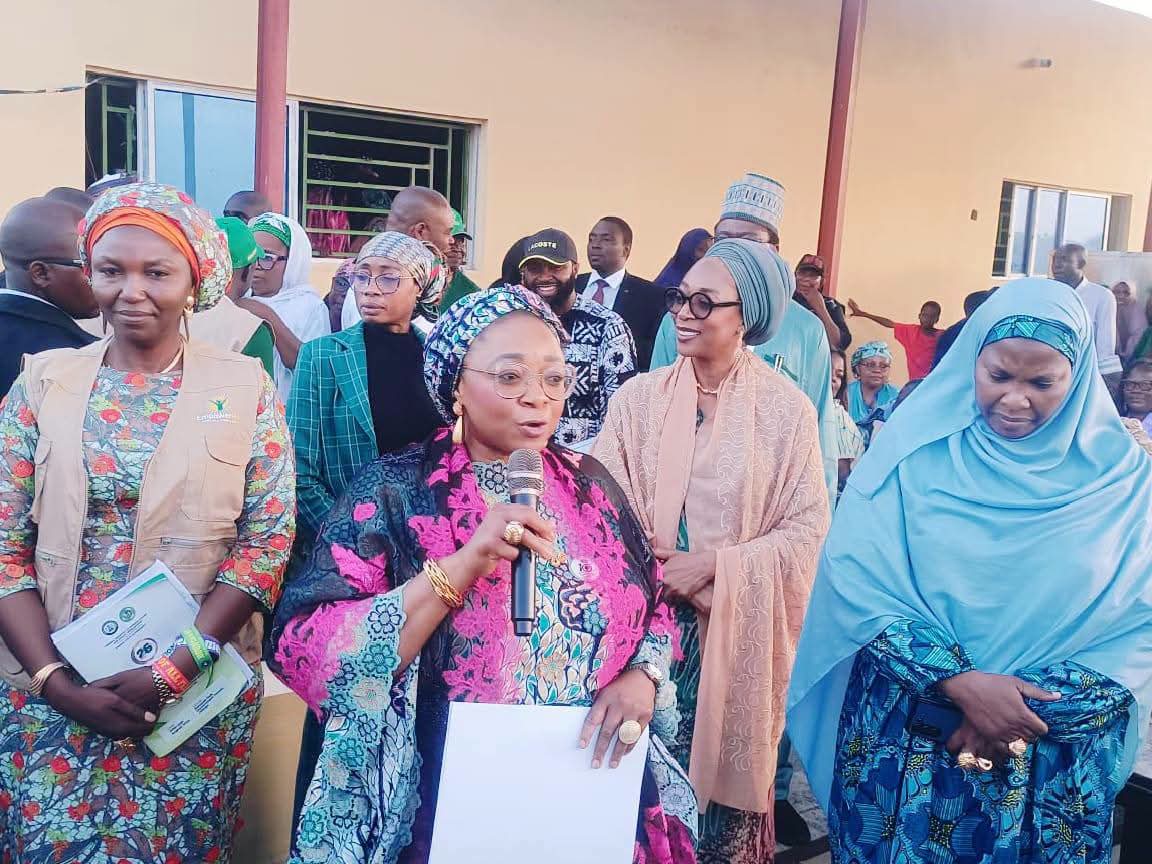
The Federal Government is strengthening efforts to empower women economically and improve livelihoods at the grassroots through the Nigeria for Women Project Scale-Up (NFWP-SU).
The Minister of Women Affairs and Social Development, Hajiya Imaan Sulaiman-Ibrahim, stated this during an inspection of the implementation of the programme in Zing Local Government Area of Taraba State.
Read also: Court Strikes Out FG’s Case Against Fake PFIPC DG
The Minister, who visited the area to assess the impact of the programme and interact with beneficiaries, commended the Taraba State Government, World Bank, State Project Coordinating Unit, Local Government Councils, traditional institutions and community leaders for their support.
Speaker commends KNSG for women empowerment initiatives
She said the visit was part of the Federal Government’s efforts to ensure that investments under President Bola Ahmed Tinubu’s Renewed Hope Agenda translate into measurable improvements in the lives of women at the grassroots.

“This visit is about seeing the impact on the ground, listening to our women and ensuring that the resources of the Federal Government are reaching the people they are intended to serve,” she said.
According to the Minister, the Nigeria for Women Project has demonstrated the impact of organising women into Women Affinity Groups (WAGs), providing financial resources, building their capacity and connecting them with sustainable economic opportunities.
She disclosed that the programme had so far empowered more than 162,445 women, established over 6,900 Women Affinity Groups, disbursed N3.548 billion in livelihood grants and mobilised more than N2.388 billion in savings among participating women.
In Taraba State, the Minister said 40 processing centres had been established across three Local Government Areas, comprising 26 groundnut, 13 rice and one oil-palm processing centres.
She described the facilities as critical platforms for moving women from subsistence production to value addition, commercial agriculture and competitive markets.
“These processing hubs are not just buildings or machines; they represent economic opportunities. They provide the pathway for our women to move from primary production to value addition, create jobs, increase productivity and strengthen Nigeria’s food and agricultural value chains,” she said.
Hajiya Imaan also commended beneficiaries for their financial discipline, noting that livelihood grants ranging from N30,000 to N60,000 had been disbursed to thousands of women, while beneficiaries had independently accumulated substantial savings through their groups.
She urged the women to maintain proper financial records, transparency and accountability in managing grants and collective assets to improve their prospects of attracting larger investments and accessing commercial markets.
The Minister further highlighted the climate-smart component of the programme, saying 170 women master trainers had been trained in briquette production and were transferring the knowledge to other members of the Women Affinity Groups.
She said the initiative would enable women to participate in green enterprises while supporting environmental sustainability and cleaner energy solutions.
Read also: NAWOJ Kano Congratulates Khadijah Aliyu on UK Media Fellowship
Hajiya Imaan disclosed that 3,604 Women Affinity Groups were established during the pilot phase, while an additional 3,296 groups were created under the Scale-Up component, bringing the total to more than 6,900 groups.
She said 85,842 women were empowered during the pilot phase, exceeding the original target of 54,000, while the Scale-Up component had mobilised an additional 76,603 women.
Beyond economic empowerment, the Minister said the programme was also delivering social benefits, including the enrolment of 2,500 women into the Taraba State Contributory Health Insurance Scheme.
She added that beneficiaries had also used their social emergency funds to support community healthcare needs, including the provision of hospital beds and clean water facilities.
“The strength of NFWP-SU is that it goes beyond giving women money. It builds financial discipline, enterprise capacity, digital skills, social protection and community resilience,” she said.
The Minister called on the Taraba State Government, private-sector investors and financial institutions to deepen partnerships around the 40 processing hubs and other women-led enterprises to expand market access, create jobs and strengthen food security.
She also encouraged existing Women Affinity Group members to mentor women in newly incorporated Local Government Areas, maintain regular savings, embrace digital literacy and transition into structured Livelihood Collectives capable of accessing higher-level grants and commercial markets.
Reaffirming her Ministry’s commitment to inclusive development, Hajiya Imaan said the Federal Government would continue to prioritise women at the grassroots as drivers of economic growth and social transformation.
“We will leave no woman behind. Our commitment is to ensure that every woman, regardless of where she lives, has an opportunity to participate meaningfully in the economy,” she said.
Earlier, the Taraba State Commissioner for Women Affairs and Child Development, Mrs Mary Sinjen, who represented Governor Agbu Kefas, expressed appreciation to the Federal Ministry of Women Affairs and Social Development for prioritising the state.
The Commissioner said Taraba was aligned with the Federal Government’s Renewed Hope Agenda, particularly its focus on women’s economic empowerment as a catalyst for peace, prosperity and sustainable development.
She described the NFWP-SU intervention as a major catalyst for transforming rural women from subsistence-level operators into viable commercial agricultural entrepreneurs.
Sinjen said the 40 Livelihood Collectives in Taraba demonstrated what could be achieved when rural women were provided with resources, financial literacy and effective organisational structures.
She commended the women of Zing and other participating communities for their resilience and commitment to the programme, assuring the Federal Government of the state’s continued partnership.
Read also: Respect Nigerians’ Right to Peaceful Protest-CITAD to Police
FG Invests N3.5bn to Empower 162,445 Women Across Nigeria
The Minister’s visit featured interactions with beneficiaries, inspection of livelihood and processing activities, engagement with community stakeholders and assessment of the impact of NFWP-SU interventions across the participating communities.