


The Minister of Education, Dr Maruf Tunji Alausa, has urged state governments, particularly in Northern Nigeria, to domesticate and implement federal policies and legal frameworks aimed at improving access to education for Almajiri and out-of-school children.
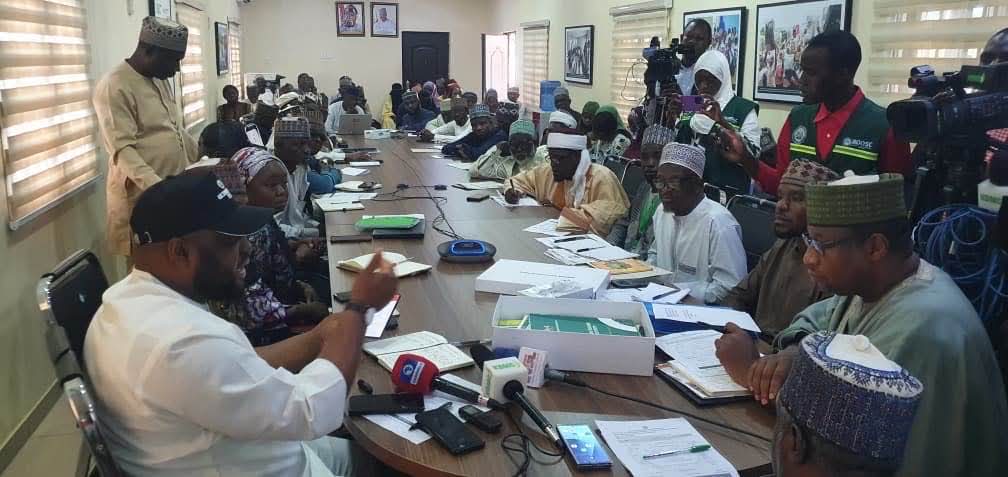
The Minister, represented by his Special Adviser on Almajiri and Out-of-School Children’s Education, Dr Balarabe Shehu Kakale, made the call at a stakeholder engagement in Kaduna.
Read also: ABU Signs 10-Year Pact With Japan’s Yamaguchi University
Dr Alausa said the frameworks included the Almajiri and Out-of-School Children Education Act, the operationalisation of Section 15 of the Universal Basic Education Commission (UBEC) Act 2004 on Almajiri education, and the National Policy on the Enhancement of Almajiri Education.
He also identified policies covering non-state schools, technical and vocational education and training (TVET), alternative learning pathways, education data infrastructure and teacher development.
The Minister further referenced Nigeria’s commitments to inclusive education under relevant ECOWAS provisions and the UNESCO ISCE Declaration, urging states to align their education systems with these commitments.

Also speaking, the Executive Secretary of the National Commission for Almajiri and Out-of-School Children’s Education (NCAOOSCE), Dr Muhammad Sani Idris, said the Commission was committed to transforming Almajiri education through consultation, inclusion and practical interventions.
Represented by Malam Halliru Musa Halliru, the Executive Secretary highlighted the Commission’s development of a Ten-Year Strategic Plan for 2025–2035, the establishment of 119 learning centres and the mapping of more than 700,000 out-of-school children nationwide.
He also cited the Tinubu Legacy Skills Training Institute in Kaduna, where Almajiri learners are receiving both academic and vocational training in areas including solar installation, agriculture, plumbing, tiling, POP installation, GSM repairs and information and communication technology.
Read also: Safer Schools: FG Equips Teachers With Gender, ICT Skills
According to him, learners from the institute have also recorded strong performance in examinations conducted by the National Board for Arabic and Islamic Studies.
The Kaduna State Commissioner for Education, Professor Sambo Abubakar, reaffirmed the state government’s commitment to tackling the challenge of out-of-school children.
He said Kaduna had made progress in expanding access to education, strengthening learning opportunities for vulnerable children and supporting programmes designed to integrate Almajiri learners into the formal education system.
Professor Abubakar assured that the state would continue to support initiatives aimed at ensuring that every child has access to quality education.
The stakeholder engagement brought together traditional rulers, religious leaders, Alarammas, Tsangaya leaders, representatives of government agencies, civil society organisations, development partners, education institutions and the media.
The engagement, championed by the Office of the Special Adviser to the Minister of Education on Almajiri and Out-of-School Children’s Education in collaboration with NCAOOSCE, forms part of a wider stakeholder mobilisation programme.
Read also: Kebbi Govt Approves N63.65m for 67 Law School Students
Further engagements are expected across the North-West and North-East geopolitical zones as stakeholders seek to strengthen cooperation among federal and state governments, traditional and religious institutions, communities and development partners.
The initiative is aimed at developing sustainable approaches to transforming Almajiri education and ensuring the enrolment and retention of out-of-school children in schools.