


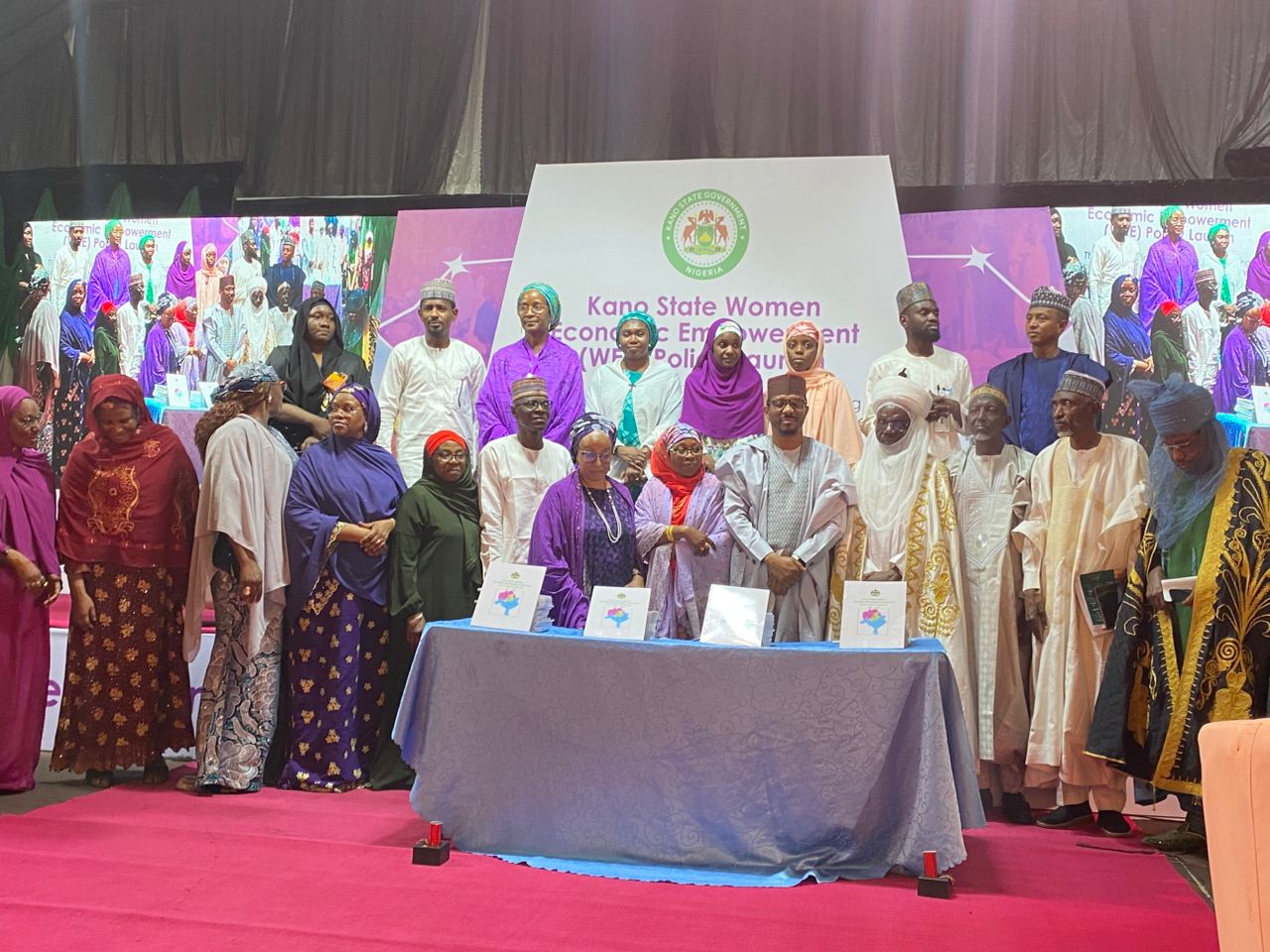
The Africa Enterprise Challenge Fund (AECF), in partnership with Isa Wali Empowerment Initiative (IWEI), Fable Advisory, the WEE Catalyst Fund, and the Development Research and Projects Centre (DRPC), has supported the domestication of the National Women’s Economic Empowerment (WEE) Policy in Kano State, strengthening the framework for women’s participation in economic activities across the state.
The domesticated policy was officially launched by the Kano State Government and adopted by the Ministry of Women Affairs, Children, and People with Special Needs. It establishes a structured approach to expanding women’s access to economic opportunities, strengthening women-led enterprises, and promoting women’s participation in economic decision-making.
Read also: Kano: Group Raises Alarm Over Emir’s Alleged Rally
The policy already guides collaboration among government, development partners, and private-sector actors to address barriers to women’s economic participation, particularly in rural and underserved communities.
Through the framework, efforts are underway to strengthen women-owned businesses, improve access to finance and skills development, and ensure women’s inclusion in key economic structures within the state.
Speaking during the launch, Fuad Farouk Umar, Program Manager for the Investing in Women in Nigeria (IIW), implemented by AECF, said the domestication of the policy provides an important institutional foundation for advancing women’s economic empowerment in Kano State.

He noted that the policy strengthens coordination between the government and development partners while ensuring that investments supporting women entrepreneurs align with a clear state-led framework.
“This policy establishes the enabling environment needed to support women’s economic participation in a structured and sustainable way. It strengthens the foundation for investments, enterprise development, and collaboration that expand economic opportunities for women across the state,” he said.
Also speaking at the event, Hauwa Umar, Gender Specialist at AECF, described the launch as a major milestone in advancing women’s economic participation.
“For us, this policy is not just a written document. It is a framework that will change the lives of women, from grassroots farmers and entrepreneurs to professionals, by giving them more economic opportunities,” she said.
Read also: Kano Gov Yusuf Submits N1.2tn 2026 Supplementary Budget
The domesticated policy reflects input from a wide range of stakeholders, including grassroots communities, private sector actors, religious institutions, and civil society organizations.
By integrating these perspectives, the policy is designed to address the realities women face while strengthening their participation in economic leadership and decision-making at both the household and community levels.
In her remarks, Hajiya Amina Sani, Kano State Commissioner for Women Affairs, Children, and People with Special Needs, described the policy as a crucial document for women’s development in the state.
She commended the Governor of Kano State, Abba Kabir Yusuf, for approving the policy and supporting its implementation.
Also speaking, Sarkin Shanu Kano Alhaji Shehu Muhammad Dankadai who doubles as the Chairman of the AECF Programme Steering Committee, highlighted the importance of the policy, noting that women made up more than half of the population.
“If you consider women and the children they raise, you are talking about nearly 75 percent of the population. Ignoring this sector can create serious challenges for society,” he said.
Sarkin emphasized that access to finance remains one of the biggest obstacles for women entrepreneurs. “Many women are educated and hardworking, but they struggle to get credit. Financial institutions need to create opportunities for women to secure loans, preferably at reduced rates,” he said.
He suggested that the government could also create special funds to offer interest-free loans for women entrepreneurs. Based on his banking experience, he observed that women usually have higher loan repayment rates than men.
Read also: Northwest Safe School Summit: Stakeholders Call for Action, Accountability
He also highlighted that women in rural areas frequently experience financial exclusion because of limited access to banking services.
The Kano State Women’s Economic Empowerment Policy aims to serve as a framework for improving women’s access to finance, skills development, and leadership opportunities, while encouraging inclusive economic growth throughout the state.