


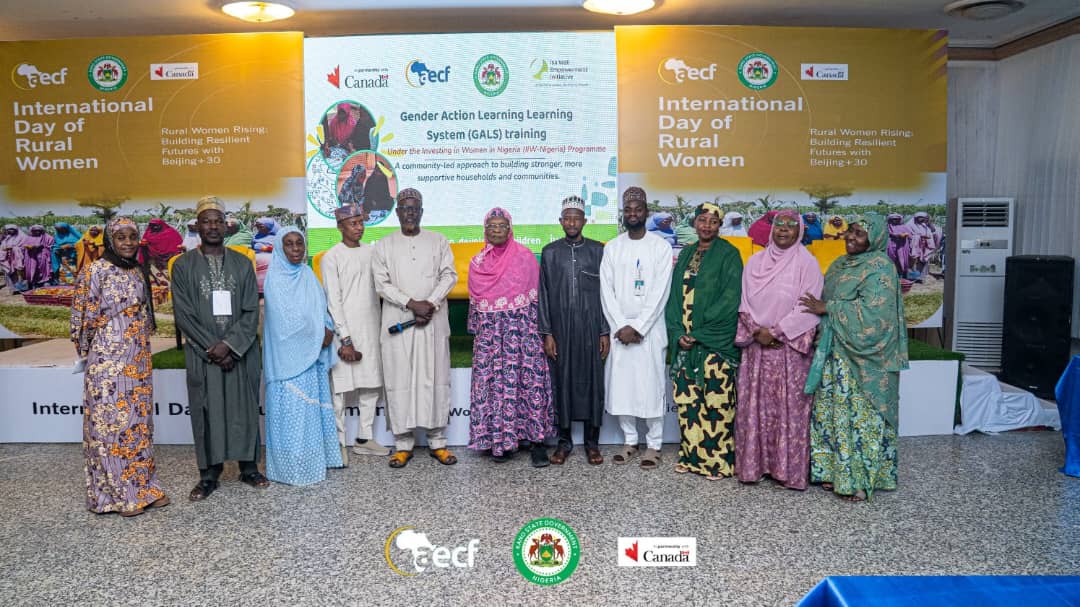
The Africa Enterprise Challenge Fund (AECF), through its Investing in Women in Nigeria (IIW-Nigeria) Programme, has launched the Gender Action Learning System (GALS) in Kano State as part of efforts to strengthen women’s economic empowerment and improve their participation in agricultural value chains.
The launch, held to commemorate the International Day of Rural Women, brought together government officials, civil society organisations, development partners, programme beneficiaries and other stakeholders to explore strategies for empowering rural women and transforming communities.
Read also: Spanish Striker Dies After Collision With Goalkeeper
Speaking at the event, Programme Manager of IIW-Nigeria, Fuad Farouk, said sustainable development must begin at the grassroots through deliberate investment in women, particularly those engaged in agricultural value chains.
AECF Targets Women-Led Agribusinesses in Kano Through IIW Nigeria
He explained that the programme adopts a three-pronged approach involving financial support for businesses and cooperatives, technical assistance and the creation of an enabling environment for women to participate meaningfully in economic activities.
According to him, AECF provides grants to businesses and cooperatives with viable proposals for integrating rural women into agricultural value chains, while offering capacity-building support to strengthen their operations and ensure the sustainability of interventions.
Mr Farouk cited an oil-processing enterprise supported by the programme, which is establishing community-based facilities where women can undertake initial processing activities before supplying their products to the company for further processing, packaging and distribution.
He said the model would provide rural women with income-generating opportunities while helping businesses establish reliable supply chains that could remain sustainable beyond the programme’s lifespan.
The Programme Manager added that AECF was also collaborating with civil society organisations, government ministries, gender champions and business membership organisations to promote gender-responsive policies and practices across Kano State.
He said the combined interventions were designed to reach 50,000 rural women in the state.
Also speaking during a panel discussion, AECF Gender Specialist, Hauwa Umar, emphasised the importance of investing in rural women, noting that the programme seeks to transform their participation in agricultural value chains, increase their incomes, improve climate resilience and strengthen their livelihoods.
The Programmes Manager of Isawali Empowerment Initiative, Ismail Abdullahi, said the organisation’s partnership with AECF had strengthened efforts to advance women’s economic empowerment in Kano State.
He explained that the collaboration began through a project supporting the Kano State Government in domesticating its Women’s Economic Empowerment Policy, which enabled both organisations to identify areas of mutual interest and expertise.
Abdullahi said the partnership was subsequently expanded under the Women Invested in Women Programme, through which Isawali was engaged to provide Gender Action Learning capacity-building support to programme beneficiaries.
Read also: Cleric Encourages Christians to Embrace Holiness, Perseverance
He disclosed that the intervention includes training 5,000 individuals, comprising 1,000 couples, on the Gender Action Learning System (GALS) methodology to promote gender equality and strengthen women’s participation in economic activities.
He described the partnership as fruitful, noting that both organisations also exchange ideas, share technical expertise and provide mutual support in implementing other development interventions.
In his keynote address, Kano State Commissioner for Rural and Community Development, Dr Abdulqadir Abdulsalam, described investment in rural women as both an economic necessity and a pathway to sustainable community development.
He observed that although women play significant roles in agricultural production, processing and household food security, they continue to face challenges relating to land ownership, access to finance, modern technology and leadership opportunities.
Dr Abdulsalam said the state government had developed a five-year integrated rural development plan aimed at improving livelihoods, with particular attention to women’s participation in agriculture.
AECF, Partners Launch Domesticated Women’s Economic Empowerment Policy in Kano
He called for stronger partnerships among government, private businesses, financial technology companies and other stakeholders to expand women’s access to markets, productive resources and modern agricultural practices.
Similarly, the Kano State Commissioner for Women Affairs, Children and Persons with Special Needs, Hajiya Amina Sani, said improving rural women’s access to education, healthcare, finance, technology, markets and decision-making opportunities was essential to reducing poverty and accelerating sustainable development.
She disclosed that the ministry had made provision in the 2026 budget for promoting backyard gardening among rural women to improve household nutrition, strengthen food security and support sustainable livelihoods.
The Commissioner added that the government was planning community gardening initiatives targeting 1,000 women, alongside a state-wide women’s summit to bring together policymakers, entrepreneurs, development partners and grassroots women to discuss issues affecting their development.
She urged development partners, private sector operators, civil society organisations and community leaders to strengthen collaboration in creating opportunities for rural women to contribute meaningfully to the state’s economic growth.
Grantees of the AECF programme, including representatives of SAGAD and L&Z, also shared their experiences, highlighting how the interventions had improved their livelihoods and created opportunities for economic empowerment.
Read also: NSCDC Moves to Curb Illegal Mining, Revenue Leakages
Participants, including Nana Babangida, Hassana Sulaiman, Halima Mohammad, Hauwa Salisu and Talatin Idi, shared testimonies on the programme’s impact, particularly in strengthening their economic activities and promoting women’s participation in agricultural value chains.
Funded by Global Affairs Canada (GAC), the Africa Enterprise Challenge Fund is a non-profit development organisation that supports innovative agribusiness and renewable energy enterprises to reduce rural poverty, build resilient communities and create employment opportunities.