


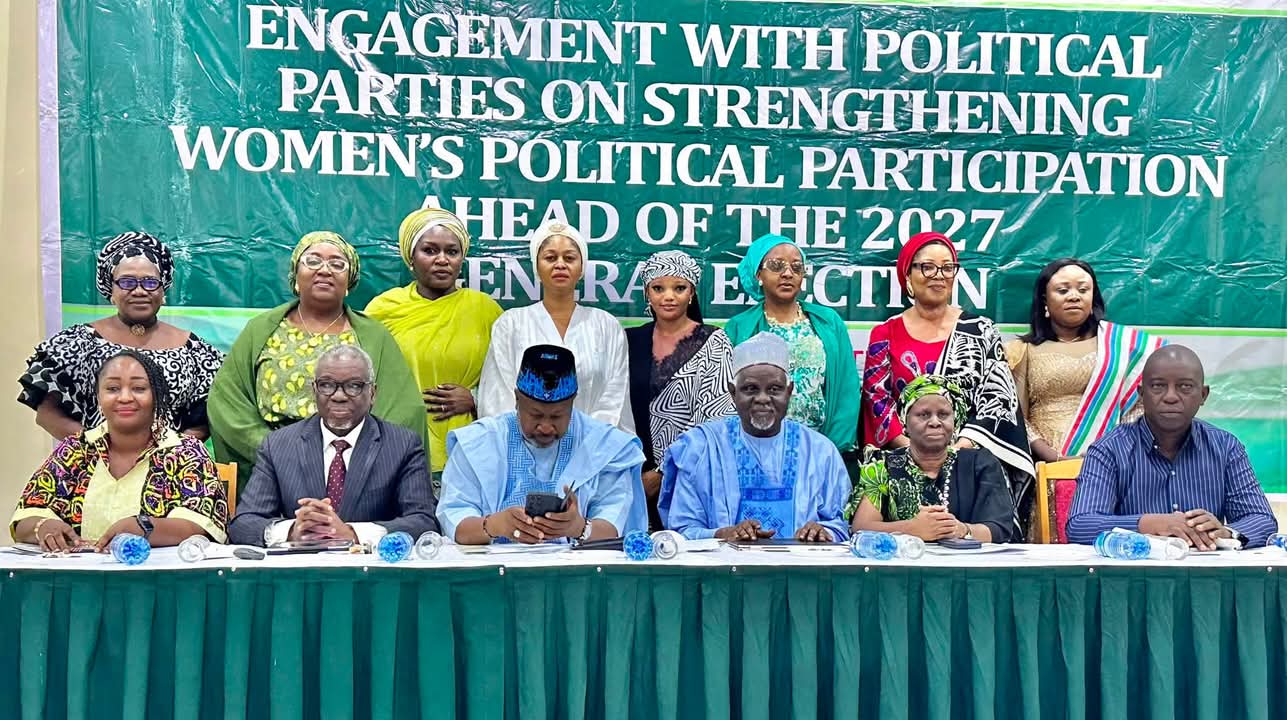
The Independent National Electoral Commission, INEC, has urged political parties to move beyond rhetoric and take concrete and measurable steps to increase women’s participation and representation in Nigeria’s political process ahead of the 2027 General Elections.
The call was made at a high-level engagement with political parties on strengthening women’s political participation, organised by INEC in Abuja.
Read also: Kano Moves to Fill Vacancies with Six Commissioner Nominees
The engagement brought together political party leaders, development partners, women’s organisations, civil society groups and other election stakeholders to develop practical strategies for improving women’s representation in elective positions.
INEC Sets November Mock Accreditation to Test BVAS Readiness
In a welcome address delivered on behalf of the Secretary to the Commission, Dr Rose Oriaran-Anthony, the Director, Gender and Inclusivity Department, Mrs Lakunuya Dorothy Bello, noted that although women continued to participate actively as voters, their representation as candidates and elected officials remained low.

She said only 1,556 of the 15,331 candidates who contested the 2023 General Election were women, representing 10.2 per cent, while only three women were elected to the Senate and 16 to the House of Representatives.
Bello said meaningful inclusion required collective action by political parties, electoral stakeholders and development partners, urging participants to identify practical measures for removing barriers to women’s political participation ahead of 2027.
Declaring the engagement open on behalf of the INEC Chairman, Professor Joash Amupitan, SAN, National Commissioner, Professor Rhoda Habor Gumus, said the Chairman was absent due to another national assignment.
She said INEC remained committed to promoting inclusive democracy, noting that women accounted for 47.5 per cent of registered voters in the 2023 General Election and constituted the majority of registrants during the final phase of the Continuous Voter Registration exercise.
Professor Gumus, however, observed that women’s strong numerical presence within the electorate had not translated into corresponding electoral success or representation in elective offices.
She challenged political parties to deliberately provide female candidates with equal access to party structures, campaign financing, media visibility, logistics, mentoring, security, fundraising networks and grassroots mobilisation.
According to her, investment in women’s political leadership should be viewed not as a concession but as an investment in the future of Nigeria’s democracy.
She also called on political parties to strengthen internal mechanisms for protecting women against intimidation, violence and discrimination, while creating sustainable pathways for women to emerge as political leaders beyond the 2027 elections.
Representing the Director-General of the Maryam Babangida National Centre for Women Development, Dr Adedayo Benjamins-Laniyi, Mrs Ijeoma Duru expressed concern over the declining number of female candidates emerging from political party primaries.
She urged political parties to provide women candidates with dedicated campaign funding, equal media visibility, enhanced security and institutional support.
Duru also renewed calls for the passage of the Special/Reserved Seats Bill, describing affirmative action as an important measure for reversing the decline in women’s political representation.
She said the Centre, in collaboration with UN Women, remained committed to supporting female candidates through digital resource centres established across the country.
In a goodwill message delivered on behalf of the UN Women Country Representative to Nigeria and ECOWAS, Ms Beatrice Eyong, Dr Susan Agada said greater women’s participation was fundamental to democratic governance, sustainable development and peace.
She identified structural barriers, discriminatory norms, inadequate political financing and electoral violence as some of the factors limiting women’s participation in politics.
Read also: ABCOAD, UNESCO Partner to Boost Technical Skills in Rice Processing
Agada called on political parties to adopt gender-responsive policies, ensure transparent nomination processes, create safe political spaces and invest in the development of female aspirants and leaders.
She assured that UN Women would continue to support Nigeria through advocacy, capacity building and strategic partnerships.
Also speaking, Mr Adebowale Olorunloshola of the Westminster Foundation for Democracy, WFD, expressed concern over Nigeria’s poor global ranking in women’s political representation despite women constituting almost half of the electorate.
2027 Elections: INEC Warns Parties Against Violence, Disinformation
He called for greater engagement with political party decision-makers, particularly those with the authority to determine candidates, saying their support was critical to achieving gender-inclusive politics.
The Chairman of the Inter-Party Advisory Council, IPAC, Dr Yusuf Mamman Dantalle, however, disagreed with claims that women’s involvement in the 2027 elections had declined.
He said available data should be properly examined before conclusions were reached, noting that some women had received support from political parties while others had relied on personal resources and efforts to participate in the political process.
Earlier, the Deputy Director, Gender, Mrs Hembadoon Akaayar, said the engagement was designed to secure firm commitments from political parties to support female candidates, ensure equitable access to campaign resources, increase women’s visibility and strengthen protection against violence and harassment.
She added that the initiative also sought to sustain support for women beyond the 2027 elections and strengthen collaboration and accountability among stakeholders.
In a keynote presentation, former Director of Voter Education and Publicity and electoral legal expert, Barrister Oluwole Osaze-Uzzi, examined global trends in women’s political participation, Nigeria’s constitutional and international obligations on gender equality, and practical pathways for improving women’s representation in governance.
He drew lessons from successful democracies in Africa and beyond, urging political parties and electoral stakeholders to adopt bold reforms capable of creating an enabling environment for women to emerge as candidates, leaders and decision-makers.
The engagement also featured a panel discussion and interactive dialogue involving political party representatives, election management experts, development partners, gender advocates and civil society organisations.
Participants examined structural, financial and socio-cultural barriers limiting women’s participation and identified practical measures for reversing the trend ahead of the 2027 General Elections.
At the end of the engagement, participants adopted a communiqué containing key issues, proposed commitments and recommendations arising from the discussions.
The communiqué was presented by Samuel Bassey and adopted by the National Chairman of the All Progressives Grand Alliance, APGA, Barrister Sylvester Sly Ezeokenwa, on behalf of IPAC.
The adoption marked a major outcome of the engagement, with participants stressing that placing women on the ballot was only the beginning, as female candidates also required adequate support to compete effectively.
In his closing remarks, the Chairman of the Outreach and Partnership Committee, Professor Abdullahi Abdu Zuru, commended participants for their contributions, describing the discussions as frank, far-reaching and constructive.
Read also: NDLEA Arrests 1,860 Suspects, Seizes 5.4 Tonnes of Drugs in Kano
Professor Zuru said the emergence of women as candidates was an important achievement but should be regarded as the beginning of a broader effort to secure meaningful participation and leadership for women in Nigerian politics.
He stressed that the period between party primaries and the general election was equally critical, urging political parties to provide female candidates with access to campaign platforms, resources, visibility, political networks and institutional support.