


The Minister of Information and National Orientation, Mohammed Idris, has urged religious leaders across Nigeria to use their influence to promote peace, national unity and responsible citizenship as the country approaches the 2027 general elections.
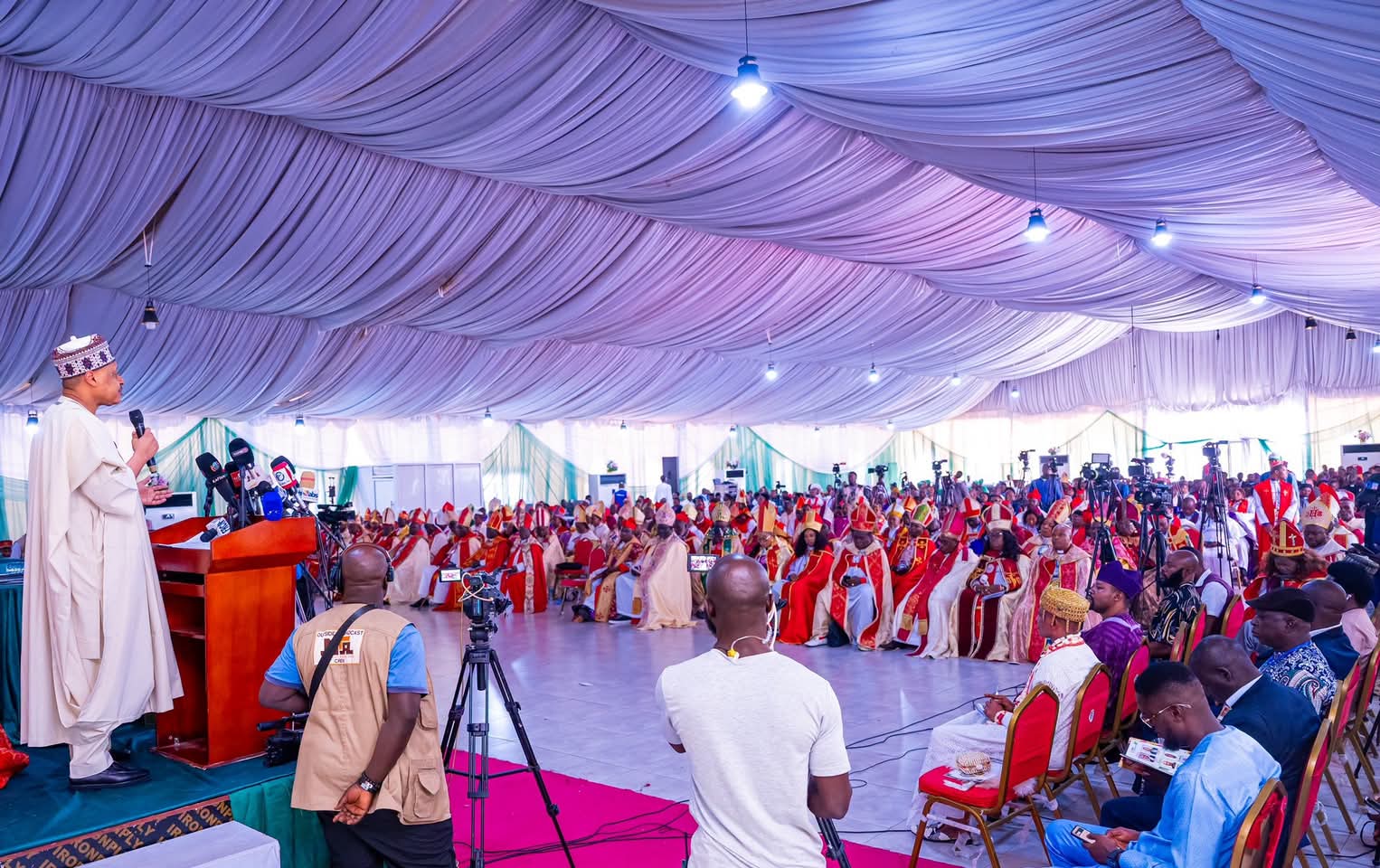
Idris made the call on Wednesday in Abuja while delivering the keynote address at the grand finale of the 2026 Synod of the Charismatic Bishops Conference of Nigeria, CBCN, and the International Communion of Charismatic Archbishops, Bishops and Apostles, ICCABA, held at the National Christian Centre.
Read also: Muslim-Muslim Ticket a Fraud to Deceive Voters, Says Bugaje
The Minister said Nigeria’s diversity in religion, ethnicity, language and political interests required responsible leadership from all sectors of society, stressing that the task of preserving national unity could not be left to government alone.
He said the Church occupied a special position in the lives of millions of Nigerians, making the influence of pastors, bishops and other religious leaders critical to maintaining peace and social cohesion.
Idris urged religious leaders to ensure that their pulpits and other communication platforms remained places for promoting truth, tolerance, peaceful engagement and responsible citizenship, particularly at a time when misinformation, hate speech and religious intolerance could spread rapidly.
He cautioned against allowing political disagreements to degenerate into religious or ethnic hostility, saying Nigerians had the right to support candidates and political parties of their choice without resorting to violence.
“No election should be allowed to turn Christian against Muslim, Muslim against Christian, North against South, or one ethnic group against another. Nigeria belongs to all of us,” he said.
The Minister also reaffirmed the Federal Government’s commitment to protecting religious freedom, stressing that Christians, Muslims and adherents of other faiths should be able to worship and practise their beliefs without discrimination or fear.
He urged Nigerians not to portray the country’s security challenges as a religious war, noting that terrorist and criminal groups had attacked citizens across different faiths and backgrounds.
According to Idris, the Federal Government, under President Bola Ahmed Tinubu, has strengthened intelligence gathering, inter-agency coordination, military operations, logistics and the wider national security architecture.
He said approximately 1,000 terrorist elements, including dozens of their leaders, were eliminated in the first quarter of 2026, while security agencies in August rescued 308 abducted Nigerians in Niger and Kwara States through a coordinated intelligence-led operation.
Read also: ACF Appoints Three-Member Interim Leadership in Kano
Idris, however, stressed that the responsibility for building a secure society extended beyond the military and police, urging religious leaders to help prevent radicalisation, guide young people away from criminality and promote dialogue in response to social, political and economic grievances.
On the economy, the Minister said the Tinubu administration had undertaken reforms, including the removal of the petrol subsidy and changes to the foreign exchange system, with the objective of creating a more productive and sustainable economy.
He listed government programmes such as the Nigeria Education Loan Fund, NELFUND; 3 Million Technical Talent, 3MTT; Nigeria Youth Investment Fund, NYIF; National Youth Talent Export Programme, NATEP; Student Venture Capital Grant, SVCG; Skill-Up Artisans Programme, SUPA; and Investment in Digital and Creative Enterprises, iDICE, as part of efforts to expand opportunities for young Nigerians.
Idris described Nigeria’s human capital as one of the country’s greatest resources and called on churches to deepen their contributions to education, healthcare, vocational training, youth empowerment, humanitarian services and community development.
He also urged religious organisations to support entrepreneurship, skills acquisition, discipline and respect for the dignity of work while encouraging young Nigerians to contribute to national development.
The Minister said national orientation could not be achieved by government alone, stressing the need for families, schools, traditional institutions, religious organisations, the media and civil society to work together in promoting accurate information, civic responsibility and national consciousness.
He warned religious leaders and other public figures to be mindful of their words, noting that statements from respected leaders could either calm communities or inflame tensions.
Idris said Nigeria was undergoing an important period of economic and institutional transition, adding that disagreements, criticism and political contests were natural features of democracy but should not undermine the country’s unity and long-term interests.
He commended the CBCN and ICCABA for bringing together church leaders from across the 36 states of the federation and the Federal Capital Territory, and expressed hope that the outcome of the Synod would translate into stronger communities and a more peaceful Nigeria.
Read also: Kano Assembly Confirms Six Commissioner Nominees
He said elections were temporary moments in the life of a nation, while Nigeria would endure beyond electoral cycles, governments and political parties.
The Minister therefore called on Nigerians to protect the country’s peace, strengthen national unity and safeguard its future for generations to come.