


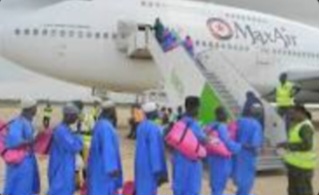
Nigerian pilgrims preparing for the 2026 Hajj face unprecedented uncertainty as a brewing diplomatic crisis between Nigeria’s National Hajj Commission (NAHCON) and Saudi Arabia’s General Authority of Civil Aviation (GACA) threatens to ground flights before they even take off.
Reports authoritatively reveal that a fierce face-off between Saudi GACA and NAHCON is imminent, stemming from what Saudi authorities deem a blatant and persistent violation of a binding bilateral agreement.
Highly placed sources within GACA have confirmed for our publication that the authority is prepared to take the drastic step of denying landing slots to Nigerian carriers if NAHCON fails to immediately honour the 50% allocation of pilgrims to Saudi-designated airlines, as mandated by the Bilateral Air Services Agreement (BASA) signed in 2015.
In addition, it was observed that NAHCON has not released the flight schedule to GACA, a development that poses serious risks and could potentially hold the country to ransom.
“The issue at hand is a clear violation. The allocation given to Nigerian carriers dwarfs that of the Saudi air carriers. The agreement is not being respected, and patience is wearing thin,” a source familiar with the escalating communications between the bodies stated.
A Crisis of Allocation and Alleged Internal Sabotage

Documents obtained revealed that on December 22, 2025, NAHCON’s Commissioner of Operations issued appointment letters to airlines, allocating states and provisional pilgrim numbers for the 2026 airlift. But the plans began unravelling almost immediately.
States like Kaduna and Niger, which were each initially projected to send 7,000 pilgrims, are now struggling to produce even 3,000 combined – a catastrophic shortfall of over 4,000 pilgrims. These states had been allocated to Flynas, the Saudi-designated carrier. Instead of adjusting the overall allocation to maintain BASA compliance, NAHCON simply refused to readjust the numbers.
The result? Nigerian airlines Max Air, UMZA Air, and Air Peace have seen their allocations surge beyond their initial provisions, while Flynas sits significantly underutilised. Air Peace alone has been allocated 7,000 pilgrims for 2026, a dramatic jump from the 4,000 it carried in 2025.
“Why will you allocate 7,000 pilgrims to Air Peace and dump the BASA agreement?” an insider at NAHCON asked, speaking on condition of anonymity. “Last year Air Peace airlifted 4,000 pilgrims, and suddenly this year it jumped to 7,000 after we initially reduced our slots. There appears to be a suspicious situation.
Fingers point to the Commissioner of Operations.
Multiple sources within NAHCON have directed blame squarely at Commissioner of Operations Prince Anofiu Elegushi, whose portfolio includes airline allocation and BASA compliance.
Insiders assert that Elegushi is prepared to disrupt the Hajj operations if his bid remains unfulfilled. What is clear, according to sources, is a pattern of incompetence compounded by interference from the commissioner’s retired special assistant, identified as Gaffar, whose continued involvement in aviation matters despite his retirement has raised eyebrows within the commission.
“The commissioner’s incompetence and that of the person handling the aviation unit, plus the illegal intervention of his retired special assistant, are what might cause Nigerian pilgrims undue hardship,” one source stated bluntly.
A Decade of Broken Promises
An aviation expert familiar with the matter told Hajj Gazette that NAHCON’s regulatory indecision has been handled “with kid gloves” for far too long.
He explained that before 2010, Saudi Arabia collected royalties instead of enforcing the airlift right. When Nigeria suspended royalty payments, Saudi Arabia demanded direct implementation. Nigeria initially resisted, leading to years of tense correspondence and near diplomatic fallout.
To avert disruption to Hajj 2014, Nigeria sent a high-level delegation in August 2014 led by the then Minister of State for Foreign Affairs, Dr Nuruddeen Muhammad. Nigeria agreed to allocate 9,500 pilgrims to Saudi carriers as an interim measure.
The issue was formally settled in February 2015 at a bilateral meeting in Jeddah involving Nigeria’s Ministry of Aviation, NCAA, NAHCON, airlines, GACA, and the Saudi Ministry of Hajj. The BASA was signed by GACA’s Vice Chairman and Nigeria’s Permanent Secretary for Aviation.
“Nigeria is the only country that negotiated gradual compliance,” the former official said. “Other countries comply fully, including those with strong national airlines.”
A former senior NAHCON official, speaking on condition of anonymity, said, “Nigeria is the only country I know of that has dragged and later agreed on such gradual compliance,” the former staffer noted.
“All other countries coming for Hajj are in compliance with this policy, including those that have strong national carriers.”
The Economic Smokescreen
NAHCON officials have repeatedly justified their non-compliance by claiming they are protecting Nigerian airlines from losing business. But critics point out a glaring contradiction.
In 2023, Flynas reduced its airfare for Nigerian pilgrims by $250. Nigerian carriers, flying the same route, refused to follow suit and instead insisted on increases.
“They complain that indigenous airlines are losing business, but they don’t inform the public that Flynas reduced fares while Nigerian carriers refused,” the aviation expert noted. “This isn’t about protecting Nigerian businesses; it’s about something else entirely.”
Today, that hard-won compromise is under threat. If GACA follows through on enforcement, Nigerian pilgrims will bear the cost through flight disruptions, reduced landing slots, or outright denial of access to Saudi airports during peak Hajj operations.
This crisis did not emerge overnight. It reflects years of selective compliance, weak oversight, and opaque decision-making. The question is now whether Nigeria’s authorities will act swiftly to restore balance or allow bureaucratic missteps and internal power plays to jeopardise one of the world’s most sensitive religious operations.
The time is rapidly approaching. NAHCON must act—before GACA does.