


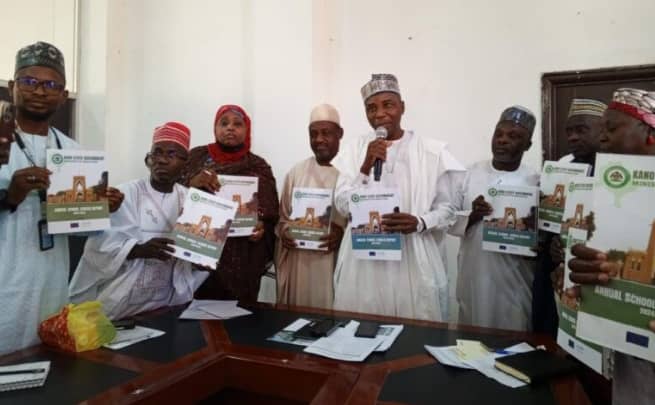
Kano State Ministry of Education has released the 2024/2025 Annual Schools Census (ASC) Report, highlighting the state government’s commitment to evidence-based education planning and improving learning outcomes across all levels of schooling.
The dissemination meeting, held at the COVID-19 Hall of the Ministry of Education, was addressed by Commissioner for Education, Ali Haruna Abubakar Makoda, who emphasized the ASC as a key tool for data-driven policy-making in the education sector.
Read also: ACF Appoints Three-Member Interim Leadership in Kano
The 2024/2025 census achieved near-universal coverage across public education sub-sectors, including Pre-Primary, Primary, Junior and Senior Secondary, Science and Technical Schools. For the first time, Non-Formal Learning Centres were also fully captured, enhancing the state’s Education Management Information System (EMIS).
A notable innovation during this cycle was the adoption of the DHIS2 digital platform, which allows real-time data entry, improves validation, reduces inconsistencies, and accelerates reporting for effective monitoring of education sector performance.
Read also: Islamic Summit in Kano Urges FG to Address Insecurity, Economic Hardship
The report highlighted encouraging gender participation, with girls accounting for a significant share of enrolment across education levels.
This reflects the positive impact of government policies promoting girls’ education and equitable access to learning opportunities.
However, challenges remain, particularly in teacher availability and infrastructure at the basic education level. High pupil–teacher and pupil–classroom ratios in some schools indicate the need for sustained investment in classroom expansion, teacher recruitment and training, and overall improvement of learning environments.
Read also: APC Presents Governorship Flag to Yusuf at 2027 Campaign Flag-Off
Dr. Makoda stressed that the Annual Schools Census goes beyond statistics. The data serves as a foundation for education planning, budgeting, teacher deployment, infrastructure development, and monitoring progress toward UN Sustainable Development Goal 4 on Quality Education. He urged stakeholders to review the findings and offer recommendations to guide the next phase of education reforms in Kano State.
The Commissioner also recognized the contributions of UNICEF, the Ministry’s Planning, Research and Statistics Department, the EMIS team, education agencies, and field officers for ensuring the successful completion of the census.