


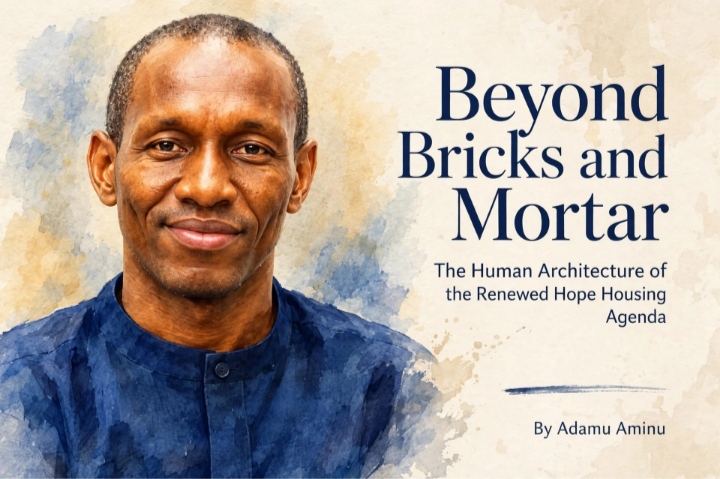
Adamu Aminu.
Nigeria’s housing deficit is often quoted in cold figures. Available estimates, including those referenced by the Federal Mortgage Bank of Nigeria and the World Bank, suggest a shortfall in the range of 17 to 22 million units, though methodologies vary. In Abuja boardrooms, we discuss allocations and procurement approvals. The language is technical. The reality is not.
Read also: Kano Steals the Show in Kaduna: Abba Yusuf Emerges as Tinubu’s Political Mobiliser
For millions, housing is not a statistic. It is dignity. It is survival. It is justice. As the Hausa saying goes, “Gida shine ginshikin rayuwa” “Home is the foundation of life.” Without it, available evidence suggests productivity, health outcomes, and educational stability tend to decline.
A roof should not be a luxury. Yet for a significant segment of the population, it remains so.
The Renewed Hope agenda, as articulated by the Federal Ministry of Housing and Urban Development (FMHUD), must look beyond bricks and mortar. Analysis indicates that true development may be less accurately measured by how high we build and more by how stable we make families.

Our strategy appears to require a shift from an administrative contract to a social compact. Shelter, in policy terms, is the bedrock of human architecture.
The deficit has human faces, and available data points to three distinct but interconnected groups.
First, the urban worker. The teacher in Lugbe. The clerk in Rimin Kebe. The civil servant who, according to National Bureau of Statistics consumption patterns, may spend 40 to 60 percent of his income on rent. He lives far from the centre because the centre is expensive. He commutes for hours. For him, owning a home is not status; it appears to be security after retirement.
Second, the artisanal builder. The bricklayer in Kano. The carpenter in Kaduna. The electrician in Sokoto. Industry estimates suggest that every one-billion-naira housing investment can generate hundreds of direct and indirect jobs.
A housing site is their market. When projects stall due to bureaucracy or costly materials, available evidence suggests they lose income, and the informal economy around them slows.
Read also: Continuity and Shared Development: My Position on Kano State and Nigeria
Third, the low-income regional family. For them, a secure home is protection against displacement. When economic and environmental pressures mount in rural areas, families tend to move to cities. Cities swell, slums expand, and infrastructure comes under strain.
We must, therefore, shift from procurement to policy. Three reforms appear critical based on current sector reviews.
One, democratize mortgages. Data from the Central Bank of Nigeria indicates that mortgage penetration remains below 1 percent of GDP, compared to significantly higher rates in peer economies. Making single-digit, long-term loans accessible to ordinary Nigerians — not just the elite — would allow traders and artisans to use verifiable daily earnings to build equity. A mortgage should not be a privilege for the few.
Two, unlock land administration. The process for Certificates of Occupancy is widely reported to be slow, costly, and opaque, often taking months or years. Digitization and simplification, as piloted in some states, suggest potential for improved efficiency. Dead capital must become live capital.
Three, localize materials. Heavy reliance on imported inputs exposes the sector to exchange rate volatility. A strategy focused on increased local production of cement, steel, and research-backed alternatives may reduce cost pressures. Housing independence appears to require material independence.
People do not appear to trust government because of press releases. Trust, available experience suggests, is more likely earned when a young couple walks into a modest, compliant estate, accesses fair financing, and turns a key to their own door.
We are not just building houses. We are building communities, stabilizing families, and restoring the social contract.
For in the end, governance is arguably not judged by blocks laid, but by lives sheltered. Not by walls erected, but by hope made habitable.
Read also: Kano 2027: NDC Drags INEC to Court Over Gwarzo’s Exclusion
Adamu Aminu
SA Media to the Hon. Minister of State, FMHUD, writes on housing policy, urban development and the human side of governance. From Kano.
Disclaimer: This is a personal opinion, not an official statement of FMHUD.