

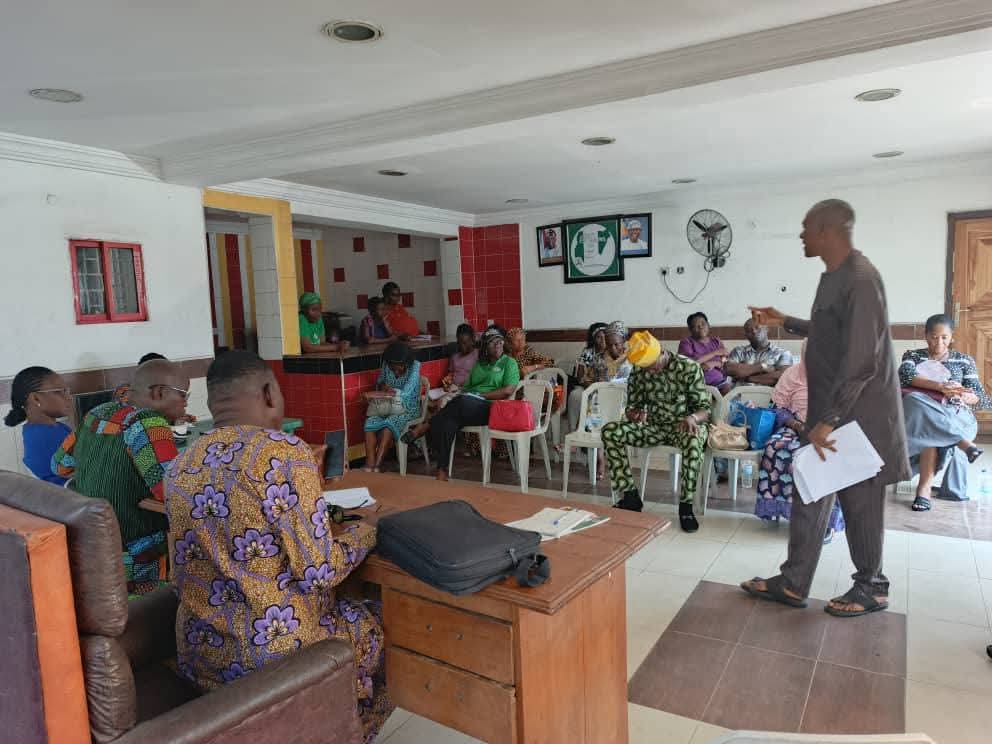
The Lagos State Directorate of the National Orientation Agency (NOA) has commenced a three-week capacity-building programme aimed at strengthening the skills and effectiveness of staff across all cadres.
The training, which began on Tuesday, January 6, 2026, at the agency’s state headquarters in Dopemu, is designed to enhance institutional capacity, improve programme delivery and strengthen the implementation of NOA’s mandate at both state and local government levels.
Declaring the programme open, the Deputy Director, Human Resources and Finance, Mrs Aderoju Echioda, who represented the State Director, urged participants in the first batch—comprising Deputy Directors and Assistant Directors—to approach the training with seriousness and commitment. She said the initiative would improve leadership, coordination, communication and administrative efficiency across the agency.

A session on Managing NOA Local Government Offices for Effective Programme Implementation was delivered by the Deputy Director, Civic Values and Democracy Education, Ms Zandra Eguavoen. She stressed the importance of synergy between Community Orientation and Mobilisation Officers (COMOs), their staff and relevant stakeholders at the local government level to ensure seamless programme execution.
Also speaking, the Deputy Director, Environment, Climate and Energy, Mr Gbolahan Aroyewun, presented a paper on Understanding the New Tax Law and the Imperativeness of Adequate Sensitisation. He underscored the role of NOA officers in educating the public on tax reforms, noting that proper sensitisation was critical to counter misinformation and help Nigerians understand the objectives, benefits and exemptions of the new law.
In her presentation on Building Synergy with Relevant Stakeholders in Delivering NOA Mandates, an Assistant Director and COMO in charge of Eti-Osa Local Government Area, Mrs Hauwa Giwa, emphasised the need for officers to fully understand government policies and programmes to effectively drive value reorientation and identify key stakeholders.
The importance of effective reporting was highlighted by Mrs Rahmat Aminu of the Planning, Research and Strategy (PRS) Department, who spoke on progress report writing. She outlined the standard reporting format and advised staff to clearly state objectives and provide accurate details of participants, including names, organisations and designations.
The second day of the training featured a presentation by a Deputy Director, Mr Toyin Muhammed, on the National Values Charter. He explained the relevance of the charter in promoting patriotism, discipline, accountability and peaceful coexistence, while highlighting its “7-for-7” components.

Mrs Echioda also delivered a session on effective supervision of subordinates, stressing the responsibility of senior officers to mentor junior staff, enforce discipline and instil professionalism and organisational values, particularly at the local government level.
The training programme coordinator and Deputy Director, Planning, Research and Strategy, Mr Cosmas Olatunde Oluyemo, delivered a lecture on general report writing techniques, emphasising accuracy, clarity and proper documentation as essential tools for effective communication and planning within the agency.
Participants described the two-day training, which was highly interactive, as timely and impactful.
They noted that the practical sessions and discussions had improved their understanding of leadership, programme implementation, reporting standards and community engagement, and commended the initiative for strengthening operational effectiveness across the agency.