


Nafisa Murtala Ahmed
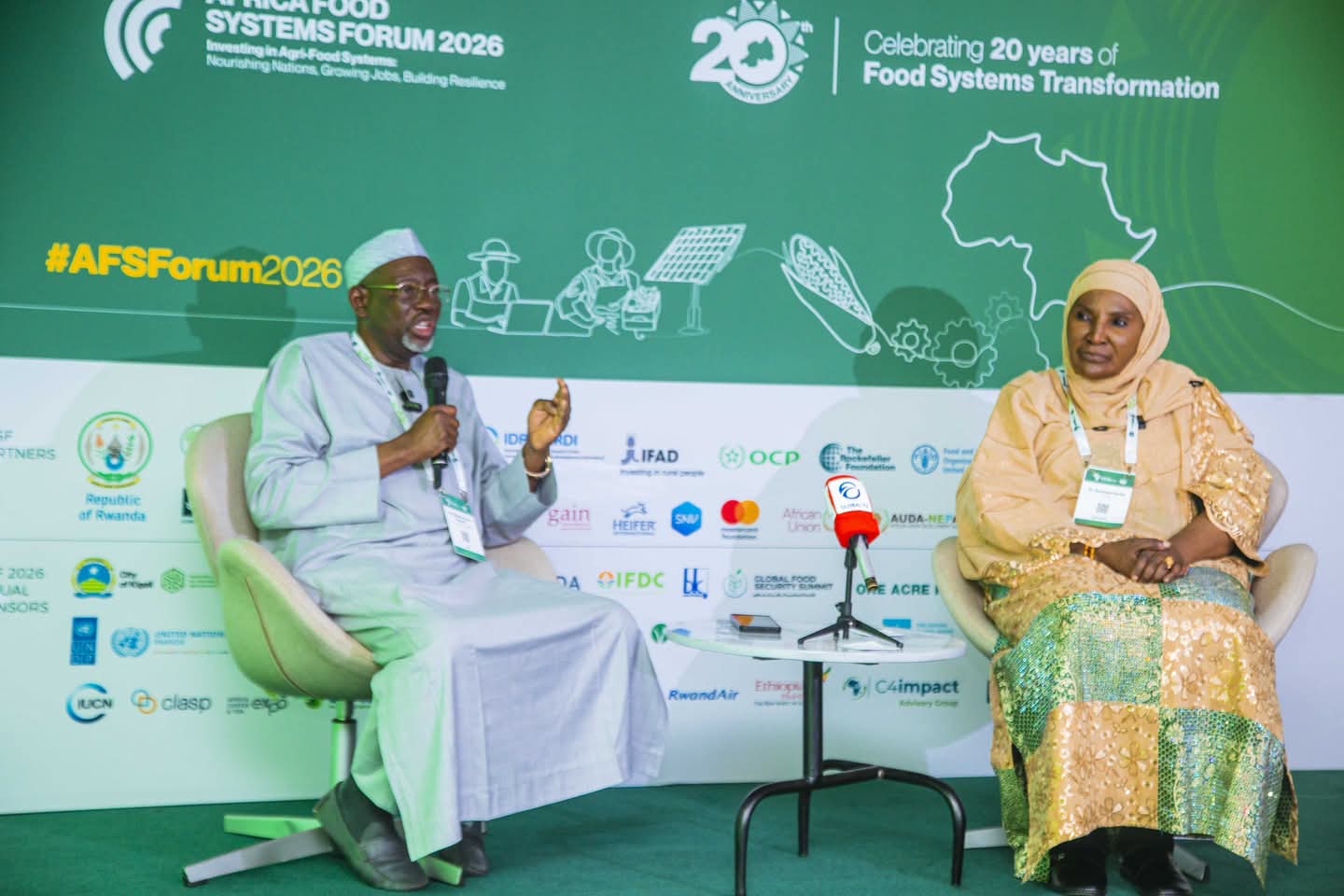
The Jigawa State Government and the Women Farmers Advancement Network (WOFAN) are set to expand collaboration on agricultural transformation, food security and economic empowerment for women, youth and persons with disabilities under the WOFAN-ICON2 Project.
Read also: WOFAN Turns Years of Hardship into Renewed Hope for Spinal Cord Patient in Jigawa
The commitment was made during a joint media interaction involving the Jigawa State Governor, Malam Umar A. Namadi, and WOFAN Founder and Global Advocate, Hajiya Dr Salamatu Garba, on the sidelines of the 2026 Africa Food Systems Forum (AFSF) in Kigali, Rwanda, on Tuesday.
The engagement brought together journalists covering agriculture and development issues as well as members of the WOFAN Media Team at the continental forum, which attracted policymakers, researchers, farmer organisations, development partners, private sector representatives and scientists working on sustainable food systems and agricultural transformation in Africa.
Governor Namadi said Jigawa had continued to benefit significantly from its participation in the Africa Food Systems Forum, noting that several agricultural reforms implemented by his administration were inspired by ideas, innovations and partnerships developed at previous editions of the summit.
He recalled that one of the key outcomes from an earlier forum was the need for a dedicated institution to coordinate agricultural transformation, which led to the establishment of the Jigawa State Agricultural Transformation Agency (JISATA).
According to him, JISATA has become one of the major drivers of the state’s agricultural development.
The governor said the 2026 forum had created new opportunities for strategic partnerships that would further strengthen rice production, livestock development, mechanisation and agricultural investment in Jigawa.
Governor Namadi commended WOFAN for its contributions to empowering women, youth and persons with disabilities through inclusive agricultural interventions.
He assured the organisation that the state government would address challenges limiting the expansion of its programmes and provide additional support to enable it scale up its activities across Jigawa.
“Everybody knows what WOFAN is doing in Nigeria in terms of empowering women in agriculture, empowering youth and people living with disabilities. This is a programme every serious government needs to work with and replicate,” the governor said.
He added that WOFAN’s inclusive development model was consistent with Jigawa’s agricultural transformation agenda and the Federal Government’s food security programme.
Governor Namadi said his administration would continue to support WOFAN as both partners work towards improving livelihoods, raising agricultural productivity and strengthening food security.
He disclosed that Jigawa currently has about 1,700 agricultural extension workers providing farmers with technical support and modern agronomic practices.
He also said the state had conducted a comprehensive soil survey to enable farmers to make informed decisions on crop selection, fertiliser application and appropriate production techniques based on local soil conditions.
“Our objective is to move our farmers from subsistence agriculture to commercial farming by improving productivity, increasing incomes and strengthening technical support through extension services,” he said.
Read also: Speaker Commissions Soba Projects to Boost Education, Healthcare
In her remarks, Dr Salamatu Garba described Jigawa as one of WOFAN’s foremost partner states, attributing the organisation’s achievements in the state to the government’s enabling environment and its commitment to farmers’ welfare.
She said WOFAN currently works with more than 150 women clusters comprising about 750 groups, with each group consisting of 30 members.
According to her, the interventions are reaching thousands of women, youth and persons with disabilities through climate-smart agriculture, mechanisation, financial inclusion, agribusiness development and value-chain support.
Dr Garba disclosed that nearly 10,000 farmers in Jigawa had been integrated into WOFAN’s financial inclusion programme through its partnership with United Bank for Africa (UBA).
She said the initiative had enabled beneficiaries to save proceeds from successive farming seasons and invest in sustainable agricultural enterprises.
She explained that after three farming seasons, participating farmers mobilised N27 million in savings, which WOFAN matched with another N27 million.
The combined funds enabled the farmers to acquire a multi-crop harvester, which she said was now being used by WOFAN members and neighbouring communities to improve paddy production and increase access to premium markets.
Dr Garba also disclosed that WOFAN purchased and marketed 54,000 bags of processed rice from Sara Market in Jigawa during the last production season at premium prices.
She described the development as evidence of the impact that education, financial inclusion and supportive government policies could have on rural agricultural communities.
The WOFAN founder said women processors had also become increasingly active in the rice value chain through the organisation’s women centres, which are equipped with modern processing facilities, including rice polishers and destoners.
She said the facilities had contributed to improved product quality and enhanced the competitiveness of locally processed rice.
Dr Garba announced plans by WOFAN to further expand its interventions in Jigawa under the WOFAN-ICON2 Project, particularly by supporting women processors, agro-marketers and rural entrepreneurs.
She said the organisation would also train and provide start-up capital to about 100 youth-led agribusiness enterprises as part of efforts to expand economic opportunities for young people.
She commended the Jigawa State Government for creating an environment conducive to innovation, community participation and agricultural entrepreneurship, describing farmers in the state as a model that could be replicated in other parts of Nigeria.
Read also: Federal Universities Get Green Light to Recruit Staff
Both Governor Namadi and Dr Garba stressed the importance of stronger collaboration among governments, development organisations and the private sector in transforming Africa’s agricultural sector, improving rural livelihoods and achieving sustainable food security.
They noted that platforms such as the Africa Food Systems Forum provide opportunities for governments and development partners to build practical partnerships, scale successful innovations, attract investment and accelerate inclusive agricultural development across Nigeria and Africa.