


Hamman Abdulkareem
Repeated flooding across Abuja has renewed questions about drainage infrastructure, urban planning, blocked waterways and the protection of the capital’s green areas, as residents count losses and demand urgent action from the authorities.
Read also: WOFAN Turns Years of Hardship into Renewed Hope for Spinal Cord Patient in Jigawa
Abuja’s Flood Crisis Is Becoming Impossible to Ignore
Abuja is often presented as one of Nigeria’s most carefully planned cities—a capital designed with roads, drainage corridors, green areas, residential districts and designated spaces intended to accommodate a rapidly growing population.
AMG Champions Environmental Safety Amid Kano Flooding

But after another bout of heavy rainfall left parts of the Federal Capital Territory submerged, that carefully planned image is facing a serious test.
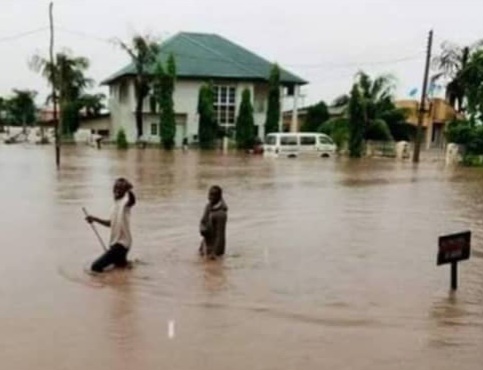
Over the weekend, heavy rain turned several roads and neighbourhoods into waterways, leaving motorists stranded and vehicles partially or completely submerged. Residents in parts of Wuse 2, Gudu, Mabushi, Lugbe, Gwarinpa and other districts witnessed the frightening speed with which floodwater accumulated.
The scenes have generated renewed anger among residents, with many asking a simple question: How can a city designed as Nigeria’s federal capital continue to struggle with flooding of this magnitude?
The latest incident has therefore become more than a weather story. It has reopened a much bigger debate about the future of Abuja, the effectiveness of its drainage system, the enforcement of planning regulations and the fate of the city’s waterways and green spaces.
When Roads Become Rivers
For residents caught in the affected areas, the flooding was not an abstract environmental problem.
Roads became difficult or impossible to navigate. Vehicles were trapped in rising water, while commuters were forced to wait for the water to recede.
Reports from the affected areas showed the extent of the problem, with flash flooding disrupting movement and raising concerns about the safety of people attempting to drive or walk through flooded roads.
The danger is particularly serious because floodwater can conceal open drainage channels, potholes and damaged road surfaces. Fast-moving water can also sweep away vehicles or pedestrians before they realise the depth or strength of the current.
That is why the FCT Emergency Management Department has warned residents against driving or walking through floodwater and has urged people living in vulnerable areas to take precautions.
The Bigger Question: What Happened to Abuja’s Master Plan?
Perhaps the most disturbing aspect of the latest flooding is that it is occurring in a city whose development was originally guided by a master plan.
The Abuja Master Plan was intended to provide a framework for orderly urban development. Yet decades of population growth, expanding construction and pressure for residential and commercial land have dramatically changed the physical character of the capital.
Environmental concerns have increasingly centred on development around waterways and the conversion of areas originally intended to serve as green spaces.
Critics argue that when natural drainage routes are blocked or when green areas that once absorbed rainfall are built over, rainwater has fewer places to go.
Instead of sinking into the soil or following designated channels, water runs rapidly across roads and into neighbourhoods.
That concern was highlighted in recent reporting, where residents and environmental observers linked flooding partly to the conversion of green areas, blocked waterways and poor waste management.
Is It Only About Heavy Rain?
The authorities and their supporters have a legitimate argument: Abuja’s flooding cannot simply be blamed on one administration or one official.
The FCT minister’s aide, Lere Olayinka, has argued that flooding predates the present administration and is connected to deeper structural problems, including rapid urbanisation, inadequate drainage capacity, illegal development and waste disposal.
He also said the FCT Administration was reviewing the Abuja Master Plan in an attempt to bring the city’s planning framework in line with present realities.
That explanation deserves consideration.
But it also raises another question:
If the problem is structural and has existed for years, why has it not been solved with the urgency expected of a national capital?
Residents do not experience flooding as a historical argument between successive administrations. They experience it as water entering their homes, damaging their property, destroying vehicles, disrupting businesses and putting lives at risk.
Abuja Was Warned
The latest flooding did not come without warnings.
Nigeria’s hydrological authorities had identified Abuja among areas exposed to significant flood risk during the 2026 rainy season. Reuters reported in April that Nigeria faced widespread flood risks, with more than 14,000 communities identified as exposed across 33 states and the Federal Capital Territory.
NiMet has also continued issuing weather forecasts and warnings about thunderstorms and rainfall across the country.
This makes the latest incident particularly important.
The central issue should not simply be whether officials could predict the rain. The more important question is whether the available warnings were translated into adequate preventive action.
Early warning is valuable only when it leads to early preparation.
Residents Also Have Responsibilities
It would be unfair to place every responsibility on government.
Poor waste disposal is one of the factors repeatedly associated with urban flooding. Plastic bottles, bags, household refuse and other materials can enter drainage channels and reduce their capacity to carry stormwater.
Read also: Affordable Housing: FG Advances 10,000 Units Across Nigeria
The FCT authorities have urged residents to clear drains, avoid construction along waterways and report developments that obstruct natural water channels.
Residents therefore have a role to play.
However, public responsibility cannot replace government enforcement.
If building regulations prohibit construction in drainage corridors, those rules must be enforced.
If waterways are illegally obstructed, the obstruction must be removed.
If waste is routinely dumped into drainage channels, sanitation regulations must be enforced consistently.
And if drainage infrastructure is inadequate for the population Abuja now carries, it must be upgraded.
The Human Cost Behind the Floodwater
Behind every photograph of a submerged vehicle is a person who may have spent years working to buy that vehicle.
Behind every flooded house is a family that may have lost furniture, electrical appliances, documents, clothing and business stock.
For traders, artisans and small business owners, even a single major flood can erase years of savings.
For low-income families, recovering from such losses can be almost impossible.
And for motorists trapped on flooded roads, the issue can move from financial loss to survival within minutes.
This is why Abuja’s flooding should not be treated merely as an inconvenience caused by heavy rain.
It is an urban safety issue.
It is an infrastructure issue.
It is an environmental issue.
And increasingly, it is a governance issue.
A Capital City at a Crossroads
The latest flooding should serve as a warning to policymakers.
Abuja cannot continue expanding while treating drainage, waterways, green spaces and floodplains as secondary considerations.
The capital needs a comprehensive flood-management strategy that goes beyond clearing drains after every major rainfall.
Such a strategy should include a detailed audit of existing drainage networks, restoration of blocked waterways, strict enforcement against construction on floodplains, protection of remaining green areas, improved waste management and stronger enforcement of the Abuja Master Plan.
The authorities should also publish clear information showing which communities have been identified as high-risk areas and what emergency measures residents should take when heavy rainfall is forecast.
The Question Nigerians Should Be Asking
The most important question coming out of the latest Abuja flooding is not whether the rain was unusually heavy.
Rain will continue to fall.
Climate patterns will continue to change.
Abuja will continue to grow.
The real question is whether the city’s infrastructure is being developed quickly enough to cope with those realities.
A planned city should not mean a city that was planned decades ago and then allowed to grow beyond the capacity of its original infrastructure.
Abuja needs planning that evolves with its population.
It needs drainage systems designed for today’s city—not yesterday’s.
It needs stronger protection for waterways and green spaces.
And above all, it needs authorities prepared to act before the next flood arrives, rather than after residents have already lost their property.
The latest images of Abuja under water should therefore not simply disappear from public memory when the roads dry.
Kano:362 Vulnerable Communities At High Risk Of Flooding-NEMA
They should become a turning point.
Because if a city designed to be the administrative heart of Africa’s most populous nation cannot adequately manage rainfall, the problem is no longer just the rain.
Read also: Speaker Commissions Soba Projects to Boost Education, Healthcare
The problem is what the city has allowed to stand in the way of the water.
Hamman Abdulkareem
Publisher hammanmedia
www.hammanmedia.com.ng