


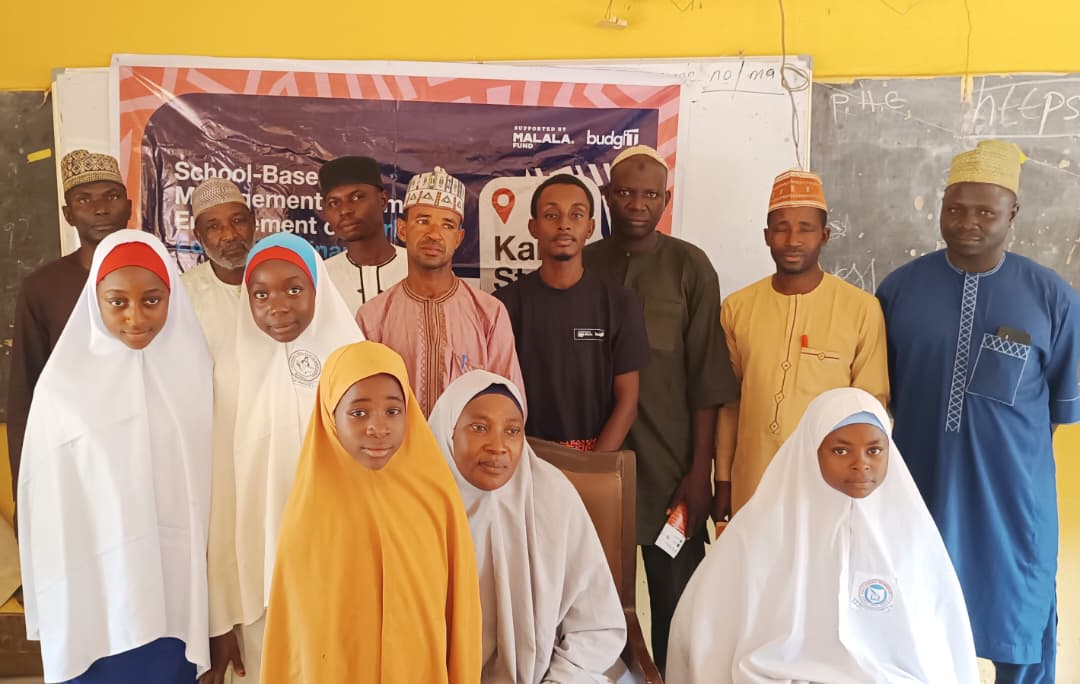
The BudgIT Foundation, with support from the Malala Fund, has organised a town hall and School-Based Management Committee (SBMC) meeting with education stakeholders in Bagwai Local Government Area of Kano State to address challenges affecting girls’ access to quality education.
The meeting, held at Bagwai Model Primary School, brought together teachers, students, head teachers, SBMC and Parent-Teacher Association (PTA) representatives, the Chief Imam of Bagwai, members of the Mothers’ Association and Old Students’ Association, as well as a representative of the Bagwai District Head.
Read also: Kebbi Govt Approves N63.65m for 67 Law School Students
Other participants included representatives of Government Girls’ Arabic Secondary School (GGASS), Government Junior Secondary School (GJSS) and Bagwai Model Primary School, alongside other community members.
The engagement was organised under the Girls’ Education Financing project, which seeks to address barriers affecting girls’ enrolment, retention, completion and academic performance.
Discussions focused on identifying challenges affecting girls’ education, examining evidence of the problems, proposing practical solutions and establishing measures for follow-up and accountability.
Participants identified cultural barriers, poverty, hawking and other forms of child labour, early marriage, inadequate teaching and learning materials, and limited awareness among parents and community leaders as major factors hindering girls’ education in the area.
Presenting the challenges facing Bagwai Model Primary School, its representative, Ibrahim Adamu, highlighted infrastructural deficiencies, including the absence of fencing around the school’s extension, insufficient classroom furniture and damaged roofs that allow rainwater to enter classrooms.
He also expressed concern over a waterlogged area within the school premises that attracts cattle rearers and mud-block makers, raising concerns about students’ safety and the proper use of the school environment.
Adamu further disclosed that the school’s computer laboratory was not functional, limiting students’ access to computer education and digital learning opportunities.
At Government Girls’ Arabic Secondary School, Bagwai, representative Lawan Alasan Umar identified damaged classroom roofs as a major challenge, explaining that the situation sometimes forces students to share already overcrowded classrooms.
Read also: Nigeria’s Development at Risk Without Girls’ Education- UNICEF
He noted that overcrowding affects students’ concentration and academic performance, particularly during examinations, while inadequate furniture and challenges affecting laboratory facilities further undermine effective teaching and learning.
Similarly, Lami Kassim Sharif, representing Government Junior Secondary School, Bagwai, highlighted inadequate fencing around the school blocks, which exposes students to distractions and raises concerns about their safety.
She also identified insufficient toilet facilities and unreliable water supply as challenges affecting students’ welfare and the general school environment.
According to her, the school has only one staffroom, forcing some teachers to use classrooms as alternative staffrooms and thereby reducing the space available for teaching and learning.
The meeting further revealed that cultural barriers and hawking remain significant concerns across the participating schools, highlighting the need for sustained community sensitisation, increased parental involvement and stronger engagement with traditional and community leaders.
Participants stressed that addressing the challenges requires not only efforts to change social attitudes but also urgent interventions to improve school infrastructure, including classroom facilities, furniture, fencing, laboratories, water supply and sanitation.
Speaking on the outcome of the engagement, BudgIT Foundation’s Kano State Officer, Maryam Usman, said participants from the three schools, identified and presented the major challenges affecting learning in their respective schools.
She explained that the findings were subsequently discussed with education stakeholders and community leaders, who examined the problems and explored practical solutions.
Read also: KIRS seeks wider tax compliance to boost Kano revenue
The town hall meeting and SBMC engagement provided a platform for stakeholders to identify barriers to girls’ education in Bagwai and discuss measures to improve learning conditions, strengthen community participation and promote greater accountability in education financing.
The engagement forms part of efforts to ensure that girls have improved access to safe, inclusive and quality education, enabling them to enrol, remain in school and complete their education.