


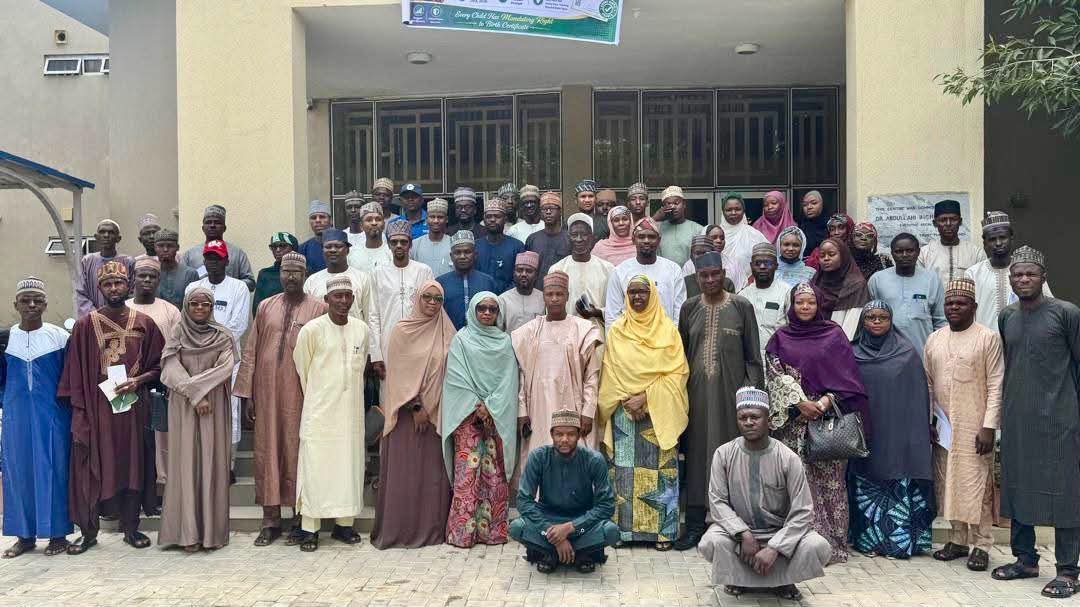
The Africa Centre of Excellence for Population Health and Policy (ACEPHAP), through the Kano State Surveillance for Evidence and Policy (KASSEP) initiative, has partnered with the National Population Commission (NPC), Kano State Office, to strengthen electronic birth registration and maternal mortality surveillance through a four-day capacity-building training.
The training, held in Kano, was designed to prepare supervisors for the pilot implementation of electronic Civil Registration and Vital Statistics (e-CRVS) and the KASSEP dashboard across 10 selected local government areas in the state.
Read also: Kano Boosts Adolescent Healthcare with 743 Facilities
NPC Unveils VitalReg Platform for Digital Birth, Death Registration
Speaking at the opening ceremony, the Director of ACEPHAP, Professor Hadiza Shehu Galadanci, described reliable data as a critical foundation for evidence-based policymaking and improved maternal and child health outcomes.
She said every child deserves legal recognition through birth registration, while every maternal death should generate information that can help prevent similar tragedies.

Professor Galadanci reaffirmed ACEPHAP’s commitment to supporting the Kano State Government and relevant institutions in building sustainable surveillance systems that promote accountability, responsive planning and improved healthcare delivery.
The Kano State Federal Commissioner of the National Population Commission, Dr. Aminu Ibrahim Tsanyawa, commended ACEPHAP and KASSEP for collaborating with the Commission to improve access to electronic birth registration.
He noted that the transition to electronic Civil Registration and Vital Statistics presents an opportunity to improve the completeness, accuracy and timeliness of birth registration in Kano State.
According to him, the pilot initiative will help ensure that every eligible child is registered and provided with an official legal identity.
Read also: KIRCT Deepens Research into Vaccines, Breast Cancer
The training focused on strengthening participants’ practical skills in electronic birth registration, maternal mortality surveillance, data retrieval and interpretation through the KASSEP dashboard.
In a presentation, Professor Baba Maiyaki stressed that data collection alone would not improve health outcomes unless the information is properly analysed and translated into action.
He urged participants to ensure that data generated from the pilot local government areas are complete, accurate and consistently reviewed to support informed decision-making and effective resource allocation.
The ACEPHAP Project Manager, Dr. Fatima Muhammad, explained that the programme combined technical presentations with practical demonstrations and hands-on exercises to equip participants with the skills required to effectively use both the e-CRVS platform and the KASSEP dashboard.
She said the pilot implementation would help identify operational challenges, document lessons learnt and refine the approach before wider expansion across the state.
Participants also received practical training on birth registration workflows, data quality assurance, address documentation, photograph requirements for National Identification Number and birth certificate processing, as well as methods for identifying and correcting common data-entry errors.
Low Awareness, Platform Charges slow E-birth Registration drive
The programme brought together officials from the Kano State Ministry of Health, Kano State Primary Healthcare Management Board, Kano State Bureau of Statistics and the National Population Commission involved in birth registration, maternal health surveillance and public health information management.
Read also: EHCON Strengthens Capacity for Safe Reptile Control
In his closing remarks, the State Director of the National Population Commission in Kano, Mr. Basheer Muhammad Dambazau, urged participants to apply the knowledge acquired during the training with diligence.
He emphasised that the success of the pilot would depend on accurate, timely and confidential data management to strengthen health planning, protect children’s rights and reduce preventable maternal deaths across Kano State.