


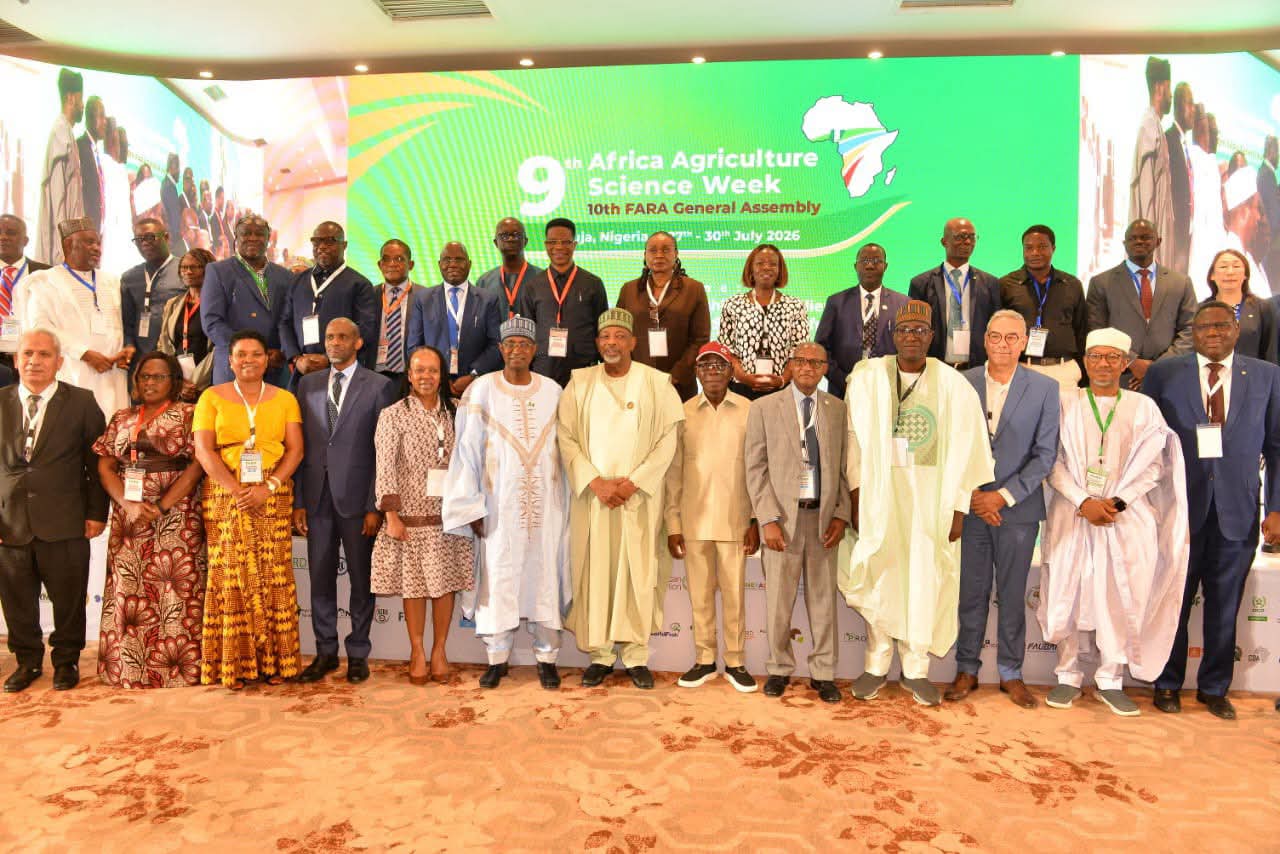
The Federal Government has called for increased investment in science, innovation and strategic partnerships to unlock Africa’s vast livestock potential and build resilient agrifood systems capable of enhancing food security, creating jobs and driving inclusive economic growth across the continent.
The Minister of Livestock Development, Alhaji Idi Mukhtar Maiha, made the call at the opening of the 9th Africa Agriculture Science Week (AASW) and the 10th General Assembly of the Forum for Agricultural Research in Africa (FARA) in Abuja.
Read also: Halt Registration Fees Before Businesses Suffer-Phone Traders to FG
AI to Transform Plateau’s Livestock Sector -LPRES
The conference, themed “Innovations and Partnerships for Resilient and Sustainable Agrifood Systems in Africa,” brought together ministers, researchers, development partners, private sector leaders and agricultural stakeholders from across the continent.
Addressing delegates, Maiha described the conference as timely, noting that Africa is grappling with climate change, rapid population growth and global economic uncertainties, which require science-driven solutions and stronger regional collaboration.

He reaffirmed Nigeria’s commitment to advancing Agricultural Research for Development (AR4D), stressing that research, innovation and cross-border partnerships are critical to achieving food security, reducing poverty and accelerating sustainable economic growth.
The minister identified livestock as a key driver of Africa’s agricultural transformation, saying resilient agrifood systems cannot be achieved without a vibrant livestock sector that supports nutrition, rural livelihoods and economic empowerment.
According to him, Africa possesses enormous livestock resources, including about 350 million cattle, 300 million sheep, 400 million goats, 20 million camels and 50 million pigs, presenting significant opportunities for investment and value addition.
Maiha acknowledged longstanding challenges facing Nigeria’s livestock sector, including low productivity, inadequate veterinary infrastructure, climate change and farmer-herder conflicts. However, he said the administration of President Bola Ahmed Tinubu has introduced far-reaching reforms to reposition the sector for sustainable growth.
He noted that the establishment of the Federal Ministry of Livestock Development in July 2024 demonstrates the government’s commitment to making livestock a major contributor to national economic development.
The minister said the recently launched National Livestock Master Plan (NLMP) and the National Livestock Growth Acceleration Strategy (NL-GAS) provide a roadmap for modernising the sector through improved production systems, stronger value chains, enhanced infrastructure, conflict mitigation and increased private sector participation.
He disclosed that Nigeria aims to increase the value of its livestock sector from 32 billion dollars to 74 billion dollars over the next decade.
Read also: Affordable Housing: FG Advances 10,000 Units Across Nigeria
To achieve this target, Maiha invited investors and development partners to invest in modern ranching, dairy processing, feed production, cold-chain logistics, veterinary pharmaceuticals, digital livestock identification and traceability systems.
He also challenged scientists and researchers to develop climate-smart technologies, including drought-resistant fodder, improved breeding methods, artificial insemination and advanced disease surveillance systems to enhance livestock productivity across Africa.
Earlier, the Minister of Agriculture and Food Security, Senator Abubakar Kyari, said Africa’s future prosperity depends on sustained investment in science, research and innovation.
He noted that successful agricultural transformation is built on strong research institutions, deliberate investment and visionary leadership, adding that the Tinubu administration has placed agriculture at the centre of its Renewed Hope Agenda because of its importance to national security, economic growth and social stability.
Kyari highlighted ongoing reforms in irrigation, mechanisation, access to improved seeds and fertilisers, agricultural financing, digital agriculture and agro-industrial development, while reaffirming the Federal Government’s commitment to strengthening agricultural research institutions, universities, extension services and innovation systems.
In his welcome address, FARA Executive Director, Dr. Aggrey Agumya, described Africa Agriculture Science Week as the continent’s foremost platform for scientific collaboration and innovation.
He observed that although Africa faces challenges such as climate change, land degradation, biodiversity loss and rapid urbanisation, the continent possesses abundant natural resources, a youthful population and growing scientific capacity to transform its agricultural sector.
Agumya called for stronger collaboration among governments, research institutions, universities, development partners, the private sector and farmers to ensure scientific innovations translate into practical solutions that improve productivity and livelihoods.
Also speaking, the Director-General of the International Institute of Tropical Agriculture (IITA), Dr. Simeon Ehui, urged African governments and development partners to strengthen investment in research, technology and innovation to accelerate agricultural transformation across the continent.
The week-long conference attracted ministers, representatives of the African Union Commission, AUDA-NEPAD, CGIAR centres, National Agricultural Research Systems, universities, development partners, private sector organisations, farmers’ associations and scientists.
Read also: Federal Universities Get Green Light to Recruit Staff
Nigeria, France Expand Collaboration to Modernise Livestock Value Chain
Participants are expected to develop practical recommendations aimed at strengthening agricultural research, stimulating investment, promoting innovation and accelerating the transformation of Africa’s agriculture and livestock sectors to improve food security, economic growth and sustainable development.