


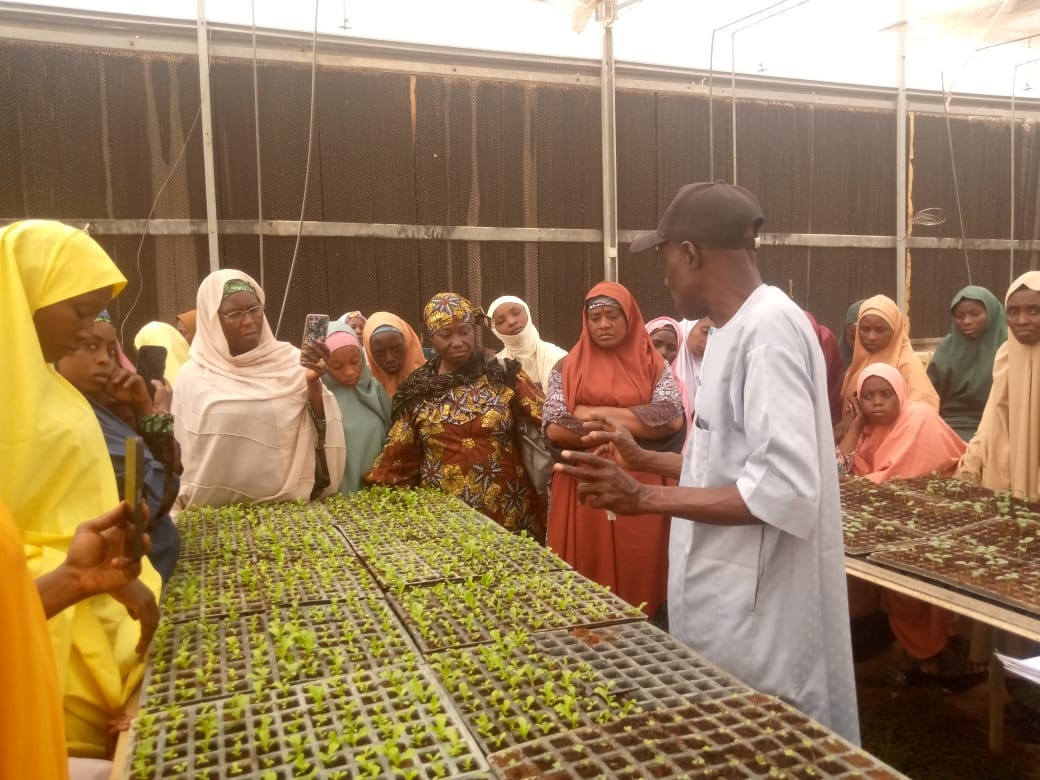
No fewer than 100 female smallholder farmers, have participated in a climate-smart agriculture (CSA) training programme, culminating in a practical field trip to the Centre for Dryland Agriculture farm.
The training was organised by the Adolescent Health Information Projects (AHIP) in collaboration with the Centre for Dryland Agriculture, Bayero University Kano, and funded by the International Organization for Migration (IOM) under its Resilient Opportunities for Outreach, Trade and Sustainability (ROOTS) project.
Read also: US Engineer Caught on Hidden Camera Poisoning Colleague
Speaking during the exercise, AHIP Programme Officer, Amina Raji, said the initiative focuses on equipping smallholder women farmers from Bunkure Local Government Area with modern farming techniques.
She explained that participants were initially trained on home-based farming methods that require minimal space, before proceeding to practical sessions at the CDA farm.
Raji described the programme as a catalyst for economic growth and food security, noting that empowering women with modern agricultural skills would enhance self-reliance.

She urged participants to remain committed to the new methods, adding that plans are underway to establish an association for the trainees, most of whom are young women.
Read also: Nine Schools Shut as Kano Begins Crackdown on Private Institutions
Also speaking, the Manager of the CDA Training and Research Farm, Ibrahim Musa Maina, said the participants were introduced to greenhouse and other modern farming techniques.
He noted that crops such as cereals, legumes, vegetables, and fruits can be cultivated at home using gardens and sack farming methods with minimal stress.
Maina reaffirmed the centre’s commitment to continuous training and retraining of farmers to achieve sustainable agricultural development.
One of the participants, Grace Musa from Bunkure, said she gained valuable knowledge on sack farming techniques.
She explained that she had previously experienced losses due to improper fertilizer application but expressed optimism that the new knowledge would improve her yield.
Grace commended the organisers and pledged to share the knowledge with others in her community.
The training highlights ongoing efforts to promote climate-smart agriculture and empower women farmers with sustainable livelihood skills.