


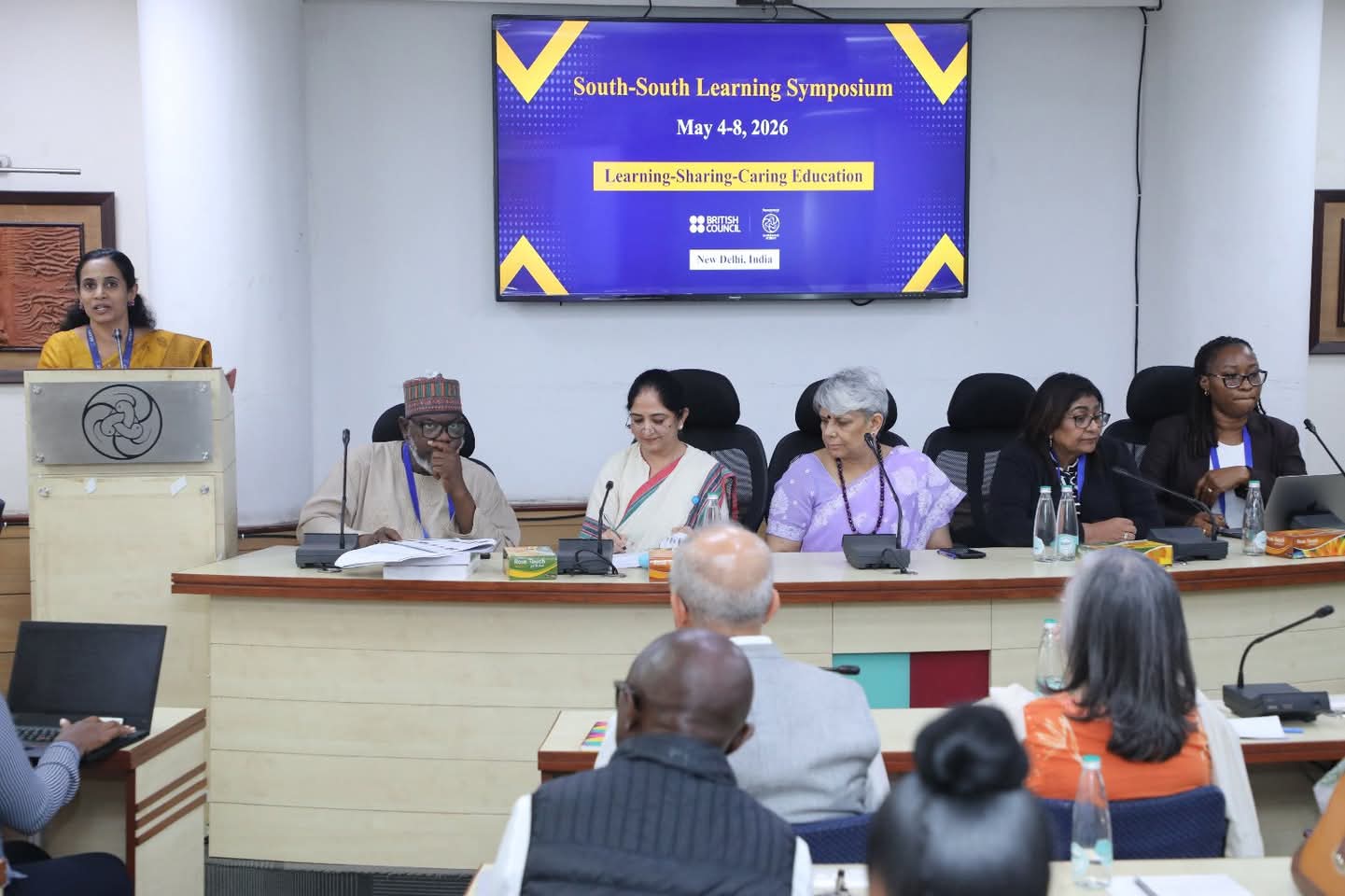
The Nigerian Educational Research and Development Council NERDC,has showcased Nigeria’s ongoing foundational learning reforms at the South-South Learning Symposium in New Delhi India.
Speaking at the symposium, the Executive Secretary of NERDC, Prof. Salisu Shehu, said Nigeria has embarked on critical education reform initiatives over the past three years under the leadership of the Minister of Education, Dr. Maruf Tunji Alausa, and the Minister of State for Education, Prof. Suwaiba Said Ahmad.
Read also: Speaker Commissions Soba Projects to Boost Education, Healthcare
Education Stakeholders Back NERDC’s ABEP Curriculum Review
According to him, the reforms are aimed at improving the quality of education delivery, particularly at the foundational level.
Prof. Shehu explained that the National Education Sector Reform Initiative (NESRI) is built on six strategic pillars, including Technical and Vocational Education and Training (TVET) expansion, STEMM education, reintegration of out-of-school children and Almajiri pupils, girl-child education, data and digitisation, as well as education quality assurance.
He noted that Nigeria’s foundational learning reforms are specifically anchored on two key policy frameworks: the National Policy on Skills Development in Formal and Non-Formal Education in Nigeria and the National Reading Framework.
According to him, while the skills development policy focuses on equipping children, adolescents, and youths with essential competencies, the National Reading Framework targets the improvement of early-grade reading skills among learners.
Read also: Indonesian Scholar Advocates Waqf Model to Transform Almajiri Education
The NERDC boss said the reforms were introduced to address alarming learning challenges in the country, revealing that about 70 per cent of Nigerian children cannot read with understanding or solve simple mathematics problems, according to findings from the 2022 Multiple Indicator Cluster Survey.
To tackle the challenge, he said NERDC initiated a holistic curriculum reform programme designed to strengthen foundational skills in English Studies and Mathematics.
Prof. Shehu identified some major features of the reforms to include the introduction of foundational skills from the pre-primary level, emphasis on practical learning methods, and alignment of numeracy content with learners’ everyday experiences.
He, however, acknowledged that implementation challenges remain, particularly the shortage of qualified teachers and inadequate access to quality instructional materials aligned with the new curriculum.
Despite the challenges, he disclosed that NERDC, in partnership with the British Council, is initiating a project aimed at providing quality instructional materials, strengthening teachers’ capacity, and ensuring a smooth transition from mother tongue to English as the language of instruction in Grade One.
Read also: Affordable Housing: FG Advances 10,000 Units Across Nigeria
Knowledge of History Vital for Nigeria’s Future -NERDC
Prof. Shehu said the initiative forms part of broader efforts to improve learning outcomes and strengthen foundational education across Nigeria.