


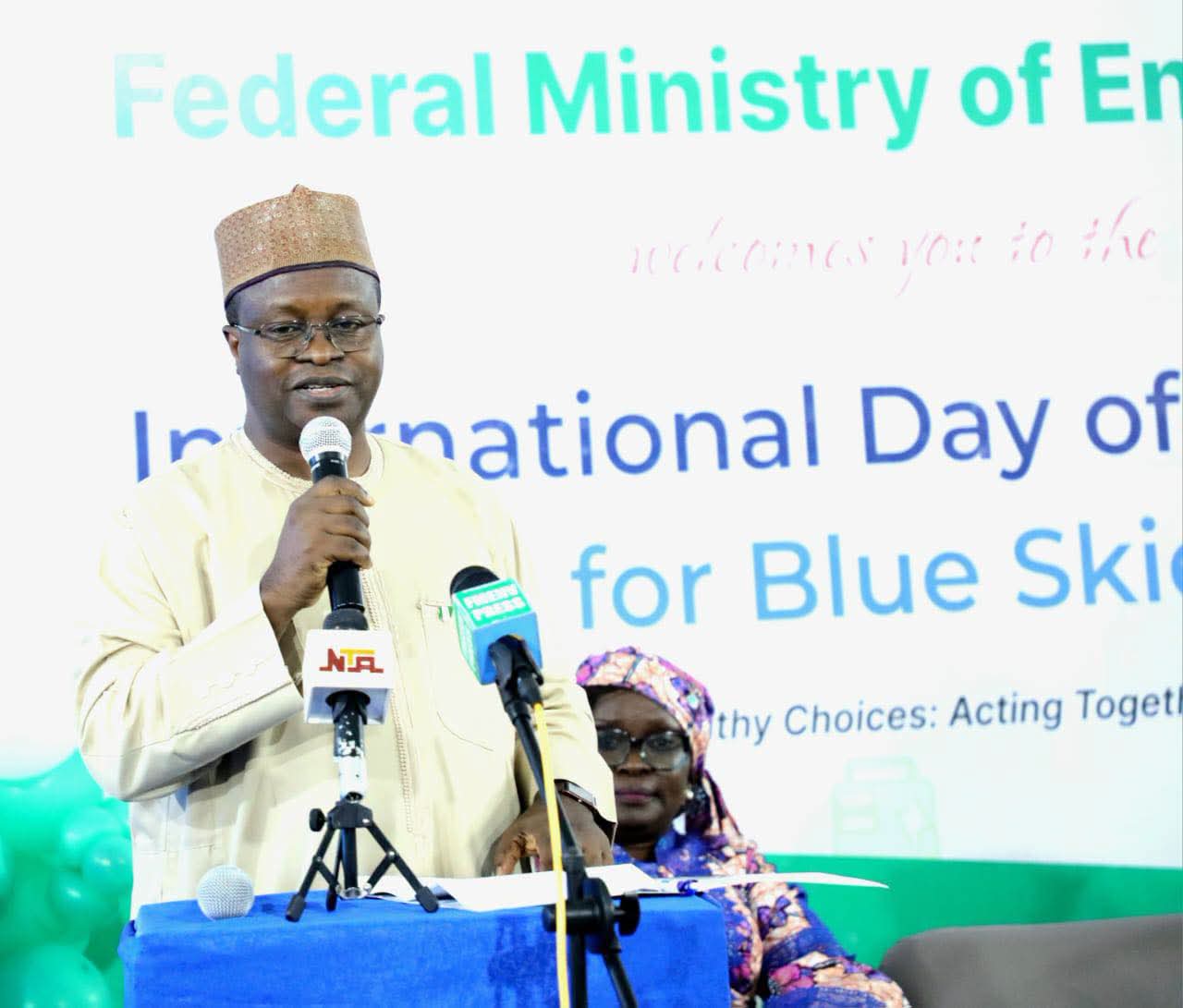
The Federal Government has called on Nigerians to make clean air a central component of the country’s environmental and development agenda.
The Minister of Environment, Balarabe Abbas Lawal, made the call in Abuja while commemorating the 2026 International Day of Clean Air for Blue Skies, with the theme, “Clean Air, Healthy Choices: Acting Together for People and Planet.”
Read also: Gombe Trains 104 Health Workers to Reduce Newborn Deaths
Niger PHCDA Launches Monthly Environmental Sanitation
The Minister, who was represented by the Permanent Secretary in the Ministry, Salihu Aminu Usman, said concerted efforts were needed to build a Nigeria where economic growth does not come at the expense of the quality of air citizens breathe.
He said the goal should be to create cleaner and healthier cities, promote responsible industrial practices, expand access to clean household energy and ensure that future generations inherit a healthier environment.

Mr Lawal described air pollution as one of the greatest environmental threats to human health globally, noting that it contributes to millions of premature deaths annually and affects ecosystems, agricultural productivity, livelihoods and community resilience.
He said the challenge was particularly significant in Nigeria due to the country’s rapidly growing population, expanding urban centres, increasing transportation needs, industrial activities, rising energy demand, waste generation, agricultural practices and continued reliance on polluting fuels.
The Minister said the Federal Ministry of Environment was working with relevant Ministries, Departments and Agencies, MDAs, sub-national governments, development partners and other stakeholders to mitigate the adverse effects of air pollution.
According to him, the ministry is deploying policy instruments, legislation, programmes and projects aimed at regulating activities, strengthening enforcement and promoting minimum air quality standards.
Mr Lawal reaffirmed the Federal Government’s commitment to working with stakeholders to strengthen air-quality management and reduce pollution across the country.
Read also: UNICEF Seeks Increased Funding for Child Nutrition in Adamawa
He appreciated development partners, government institutions, the private sector, civil society organisations, academia, the media and other participants for their continued support and partnership.
He said collective action remained critical to ensuring cleaner air and a healthier environment for Nigerians.
In her welcome address, the Director of Pollution Control and Environmental Health, Mrs Omotunde Adeola, said air pollution was a complex challenge arising from transportation, industrial activities, energy production, waste burning, household energy use and other human activities.
She stressed that tackling the problem required coordinated action and strong partnerships among government institutions, the private sector, development partners, civil society, academia, communities and citizens.
Mrs Adeola said the programme provided an opportunity to reflect on the challenges, share knowledge and highlight practical solutions for improving air quality in Nigeria.
She also said the event would promote awareness of the ministry’s ongoing efforts to tackle air pollution, including the establishment of an early warning system aimed at protecting human health.
She acknowledged the contributions of development partners and organisations that supported the programme, including the United Nations Industrial Development Organization, UNIDO, Breathe Better and Ampak.
In a goodwill message, the UNIDO representative, Reuben Bamidele, commended the Federal Ministry of Environment for bringing key stakeholders together to commemorate the International Day of Clean Air for Blue Skies.
EHCON Backs Nationwide Mapping of Dumpsites, Environmental Risks
Read also: CDA Demonstrates Improved Groundnut Varieties to Farmers
Mr Bamidele noted that the environment belonged to everyone and that the quality of human life was closely linked to environmental conditions and human activities.
He urged participants to intensify efforts to promote clean air and support environmental sustainability.