


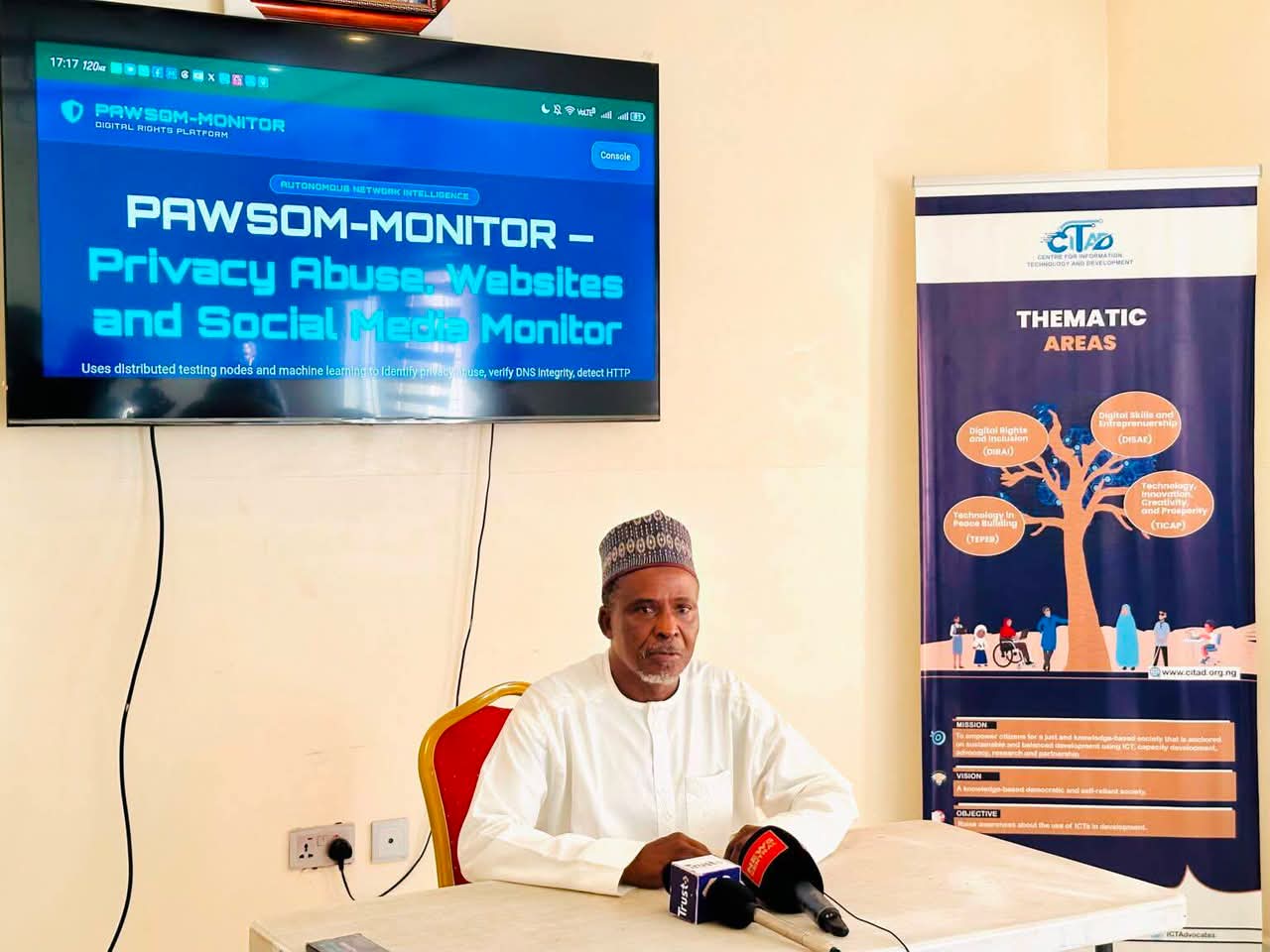
The Centre for Information Technology and Development (CITAD) has described the digital environment surrounding the 2026 Osun State Governorship Election as generally stable but moderately risky, with some political party websites recording persistent access and technical anomalies.
CITAD disclosed this in its latest report under the Privacy Abuse, Websites and Social Media Monitor (PAWSOM-MONITOR), covering August 15, 2026, including the night before the election.
Read also: CITAD, MAAUN Mark Information Access Day, Warn Against Fake News
According to the organisation, the monitoring exercise conducted 20,984 checks across 15 political party websites, recording an overall success rate of 80.58 percent and a risk score of 41 out of 100, classified as moderate.
The report noted that the latest assessment represented a slight improvement from the earlier monitoring conducted on August 8, 9 and 13, which recorded a 79.61 percent success rate and the same moderate risk score of 41 out of 100.
Of the 15 websites monitored, CITAD said 10 were classified as operational, four as operational with anomalies, while one was unreachable from its monitoring server.

The website of the Allied Peoples Movement (APM) raised the most significant concern, as all three checks conducted during the final verification period failed and repeatedly returned an “isp_block_detected” result.
CITAD, however, clarified that the finding does not establish that the APM website was deliberately blocked or restricted.
It explained that although the website returned response code 200 during the checks, the monitoring system classified it as “Unreachable From Monitor” with moderate confidence.
The Peoples Redemption Party (PRP) website was accessible during all three checks but was classified as “Operational With Anomalies”, while the websites of the Peoples Democratic Party (PDP), New Nigeria Peoples Party (NNPP) and Zenith Labour Party also recorded anomalies requiring further human review.
Overall, PAWSOM-MONITOR recorded 16,908 successful checks against 4,076 failed checks during the monitoring period.
Read also: Kebbi APC Rejects ADC Claims of Political Persecution
CITAD urged political parties to take the availability, security and reliability of their official digital platforms seriously and promptly address technical concerns that could undermine communication with voters.
It also advised parties and candidates preparing for the 2027 general elections to strengthen their websites and social media platforms against outages, account restrictions, hacking attempts, impersonation, loss of access and other forms of digital abuse.
The organisation recommended that political parties establish mechanisms for regular monitoring of their official websites and social media accounts to enable them quickly detect and respond to technical or security challenges.
It further called on parties and candidates to ensure that their official social media accounts are clearly identifiable and adequately secured against account takeover and impersonation.
CITAD stressed that no confirmed case of deliberate censorship, politically motivated website blocking or external interference was established during the reporting period.
The organisation said the automated findings generated by PAWSOM-MONITOR are signals requiring further investigation and should not, on their own, be interpreted as proof of responsibility for any disruption.
CITAD Executive Director, YZ Ya’u, said the pilot exercise also aims to assess compliance with the Nigeria Data Protection Act, particularly the use and possible abuse of voters’ personal data in the electoral process.
He explained that due to the limited deployment period of less than one week, some monitoring functions were deferred to allow the organisation to focus on website-related assessments.
Ya’u said CITAD would update PAWSOM-MONITOR in the coming weeks and deploy its full monitoring features to cover both websites and social media platforms of political parties and candidates ahead of the 2027 general elections.
Read also: Doguwa Polytechnic, Collapsed Bridges Top Kano Assembly’s Agenda
According to him, the expanded system will also track the use of voters’ personal data and help determine whether political actors are complying with the provisions of the Nigeria Data Protection Act.
CITAD said it would continue monitoring Nigeria’s digital electoral environment, with particular attention to website availability, possible access disruptions, DNS anomalies and other digital-rights concerns that could affect the meaningful participation of political parties, candidates and citizens in electoral processes.