


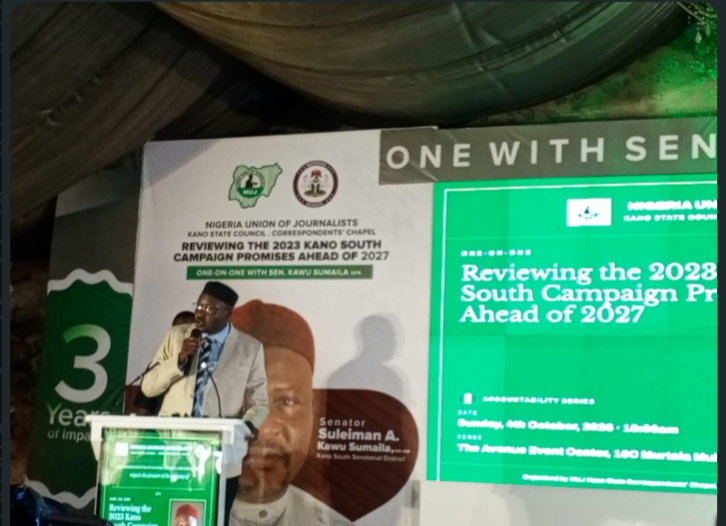
Three years into his tenure in the 10th National Assembly, Senator Abdulrahman Kawu Sumaila has placed his political future in the hands of the people he represents, challenging constituents of Kano South Senatorial District to judge him by what he has delivered rather than by political rhetoric.
For the senator, the verdict is simple: if his record of legislation, projects and interventions meets the expectations of the people, they should support him for another term. If it does not, he says, they are free to choose someone they consider better.
Read also: Agencies Must Move Beyond Activity Reporting-PS
It was this message that dominated a public accountability session organised by the Nigeria Union of Journalists (NUJ), Kano State Council, Correspondents’ Chapel, in collaboration with the senator’s office.
The session, held to review Kawu Sumaila’s 2023 campaign promises and assess his first three years in the Senate, brought together constituents, academics, religious leaders, politicians, civil society representatives and journalists.
Among those present were the Chief Imam of Sahaba Juma’at Mosque in Kano, Muhammad Bin Othman; Professor Habu Fagge of the Department of Political Science, Bayero University Kano (BUK); former Director-General of the Kano State Hisbah Board, Dr Aliyu Kibiya; political actors, constituents from the 16 local government areas of Kano South and other stakeholders.
For the senator, however, the gathering was more than another political engagement. It was an opportunity to open his books before the people and allow his performance to be examined publicly.
Looking back to October 10, 2022, when he campaigned for the Senate, Kawu Sumaila said his agenda was built around social justice and the practical needs of ordinary people.
Education, healthcare, access to water for domestic consumption and irrigation, and agricultural development, he recalled, were among the key areas he promised to prioritise.
Three years later, he said, those promises had translated into legislative interventions and development projects spread across Kano South.
His office presented about 50 major legislative interventions selected from his activities at the National Assembly, alongside approximately 103 projects and interventions implemented across the senatorial district.
The projects, according to him, represent broad categories rather than individual items. A single category involving water pumps, for example, accounts for about 6,000 individual water-pumping machines, while borehole and solar-powered water projects comprise hundreds of facilities.
Similar categorisation, he said, applies to dam-related interventions and other projects executed across the district.
The significance of the figures, therefore, lies not merely in their numerical value but in the scale and geographical spread of interventions across a senatorial district comprising 16 local government areas and 171 political wards.
Representation in a vast constituency
Representing Kano South is no small task.
The district covers a large geographical area with diverse communities and competing needs. For Kawu Sumaila, understanding those needs requires more than sitting in Abuja and waiting for complaints to arrive.
He said he had deliberately spent time studying the challenges confronting the people and understanding the procedures of the National Assembly, drawing on his previous experience in the legislature and as a former Senior Special Assistant to the President.
“If you elect someone who knows the people and knows the region, things become easier. I am always available to the people,” he said.
He also credited young members of his team for contributing to the design and implementation of some of the programmes associated with his office.
According to him, some of the young people working with him have developed sufficient skills to execute projects and initiatives without depending heavily on external consultants.
He further pointed to his grassroots connections as an important part of his approach to representation, saying members of his family and wider community network maintain close contact with residents and help his office identify local concerns.
Perhaps the most striking aspect of the gathering was the senator’s insistence that public officials should be assessed through measurable performance rather than political quarrels.
Kawu Sumaila said he accepted the NUJ invitation because he considered transparency, accountability and regular engagement with citizens essential elements of democratic governance.
He described the exercise as a shift away from political campaigns dominated by personal attacks and character assassination towards an issue-based culture in which politicians are challenged to explain their policies, decisions and achievements.
“I ask only that you do justice in your assessment, reporting and judgment, for the truth, when presented clearly, speaks for itself,” he said.
His challenge was directed not only at journalists but also at academics, political opponents, civil society groups and members of the public.
He urged them to examine the facts and data presented before reaching conclusions about his performance.
‘Hold me accountable for delivery’
The senator also questioned the tendency of some media platforms to give prominence to political insults, personal disputes and character attacks instead of interrogating the performance of elected officials.
“What you should expect from me is simply asking me to do the work,” he said.
For him, the central question should be whether an elected representative is delivering on the mandate given by the electorate.
He said public officials should be judged by their responsibilities and achievements rather than personal attributes or political disagreements.
Read also: Kebbi Gov Set for Turbaning as Garkuwan Katsina Babba
Kawu Sumaila also opened the door to further scrutiny, challenging anyone who disagreed with his account to engage him directly.
“My door is open,” he said, indicating his willingness to participate in further public discussions or debates where his record could be subjected to detailed examination.
With the 2027 general elections approaching, the accountability session inevitably carried a political undertone.
But Kawu Sumaila said he was not afraid of political competition.
With nearly 24 years of involvement in politics, he said opposition and political contestation were not new experiences for him.
What he rejected, however, was violence and political thuggery.
He maintained that political office should not be defended through intimidation or violence, insisting that the electorate should ultimately determine who represents them.
“I know what I have achieved. My point is, I went to the Senate, and there are operational procedures in the Senate. This is what I am expected to deliver, and I delivered it,” he said.
Then came perhaps his clearest challenge to Kano South.
“If they are satisfied, they are satisfied; that’s it. If they aren’t satisfied, they will look for someone better than me,” he said.
The statement effectively places his political future in the hands of the electorate.
Rather than claiming an automatic entitlement to another term, the senator says his record should determine whether he deserves one.
Kawu Sumaila also used the occasion to distance himself from activities capable of exposing young people to social harm, including drug distribution.
He pointed to his involvement in education and his responsibilities towards thousands of young people across Nigeria, stressing the need for political leaders to contribute positively to the future of the younger generation.
For him, representation goes beyond securing projects or making speeches in the National Assembly. It also involves protecting and empowering the people whose interests elected officials are expected to serve.
The NUJ Correspondents’ Chapel said the accountability session was part of its responsibility to ensure that public officials remain answerable to the people.
Chairman of the chapel, Comrade Murtala Adewale, said Section 22 of the 1999 Constitution, as amended, assigns the mass media the responsibility of holding government accountable to the people.
He said the session was therefore designed to examine how far Kawu Sumaila had fulfilled the promises made during his 2023 campaign and what he had achieved during his first three years in office.
More importantly, the NUJ wanted to interrogate why the people of Kano South should consider giving him another mandate in 2027.
That question, according to Adewale, includes whether the senator’s legislative experience, interventions and contributions in the Senate have translated into meaningful benefits for constituents.
The NUJ official commended Kawu Sumaila for accepting the invitation and publicly presenting his record, describing the initiative as an example that other elected and appointed officials should emulate.
He also assured participants that journalists would report the senator’s submissions adequately while encouraging other public office holders to subject their records to similar scrutiny.
The gathering ultimately raised a question that cannot be answered by the senator, the media, political parties or civil society organisations alone: has Kawu Sumaila done enough to earn another term?
His answer is that the people of Kano South should decide.
The presence of religious leaders, academics, politicians, community members, civil society representatives and journalists gave the accountability exercise a broader character than a conventional political meeting.
Questions and interactions focused on legislation, projects, interventions and the senator’s relationship with constituents, providing an opportunity for him to explain the thinking behind his first three years in office.
But an accountability exercise does not end with the presentation of a scorecard.
The real test comes when constituents compare promises with delivery, projects with needs, legislative activities with their impact, and political claims with evidence on the ground.
For Kawu Sumaila, the invitation is already extended.
He says anyone who disputes his record should come forward, examine the figures, question the projects and challenge his claims.
Read also: Kaoje Attacks: Kebbi Gov Approves N200m Support
Ultimately, however, it will be the people of Kano South who will have the final word.
And as the 2027 elections draw closer, that verdict may prove to be the most important assessment of his three years in the Senate.