


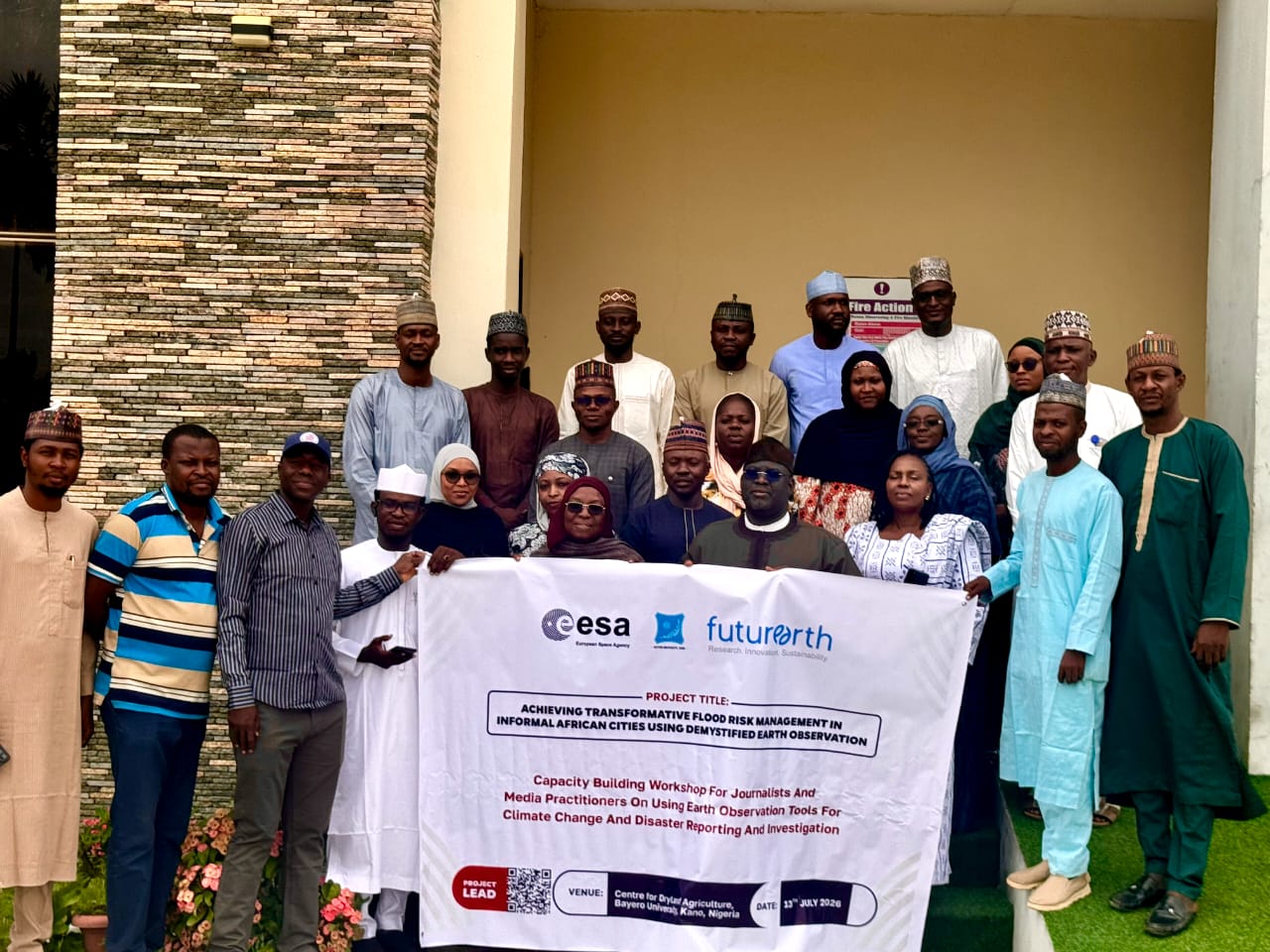
Journalists have been urged to serve as a vital link between science, society and policy by incorporating credible scientific evidence into their reporting to promote accurate and impactful coverage of environmental and climate change issues.
A professor of urban and regional planning, Bayero University Kano (BUK), Professor Aliyu Barau made the call during his opening remarks at a capacity-building workshop for journalists on the use of Earth Observation tools for climate change, disaster risk management and environmental sustainability, held in Kano.
Read also: BUK Interfaculty Games: Students Battle for Sporting Glory
The workshop, organised under a disaster reporting and investigation research project at BUK, is funded by the European Space Agency (ESA) and Future Earth.
The initiative aims to simplify the use of Earth Observation technologies for climate change monitoring and environmental reporting in Nigeria.
Professor Barau who doubles as the project lead said the media’s role extends beyond reporting events to shaping public understanding, informing policy debates, promoting accountability and amplifying the voices of communities affected by environmental challenges.

According to him, effective environmental journalism requires not only compelling storytelling but also access to credible scientific evidence capable of verifying facts, identifying trends and placing local environmental events within a broader context.
“We are gathered at a time when environmental challenges are becoming more complex and their impacts more visible than ever before. Across Nigeria and many parts of the world, we are witnessing more frequent floods, droughts, land degradation, heat waves, deforestation, pollution and biodiversity loss,” he said.
He noted that these environmental threats continue to affect livelihoods, food security, public health, infrastructure and economic development, increasing society’s demand for accurate, timely and evidence-based information.
Read also: Gombe Trains 104 Health Workers to Reduce Newborn Deaths
Professor Barau explained that Earth Observation technologies, including satellite imagery, geospatial data and remote sensing, provide reliable, objective and continuously updated information about the changing environment.
He said that for journalists, these technologies are more than maps or images, describing them as powerful tools for fact-checking, investigative reporting, data-driven storytelling and visual communication.
The professor expressed optimism that the knowledge and practical skills acquired during the workshop would enhance the quality of environmental reporting while supporting informed decision-making and stronger public engagement on climate change, disaster risk management and environmental sustainability in Nigeria.
Earlier in her welcome remarks, the Deputy Vice-Chancellor (Research and Development) BUK, Prof Amina Mustapha noted that, journalists play a crucial role in translating scientific data into compelling stories that influence policy, shape public behaviour and promote accountability.
She encouraged participants to adopt solutions journalism by investigating environmental issues and highlighting the experiences of vulnerable communities.
She reaffirmed Bayero University Kano’s commitment to supporting evidence-based environmental reporting through access to its research facilities and experts.
Professor Mustapha said Bayero University Kano would continue to support evidence-based environmental reporting by providing journalists with access to the university’s research centres, laboratories and experts to strengthen science communication.
Read also: ACF Appoints Three-Member Interim Leadership in Kano
Some participants who spoke to newsmen, including the Head of New Media at Bayero University Kano, Dr. Nura Garba, and a journalist with Arewa24, Zainab Baba Aliyu, described the workshop as timely and highly beneficial, noting that it equipped journalists with practical skills for evidence-based climate and environmental reporting.
The capacity-building workshop featured hands-on training sessions, technical presentations and a virtual presentation by the European Space Agency (ESA) Liaison for Future Earth, Freya Muir, who highlighted the role of Earth Observation technologies in strengthening climate monitoring and environmental reporting.