


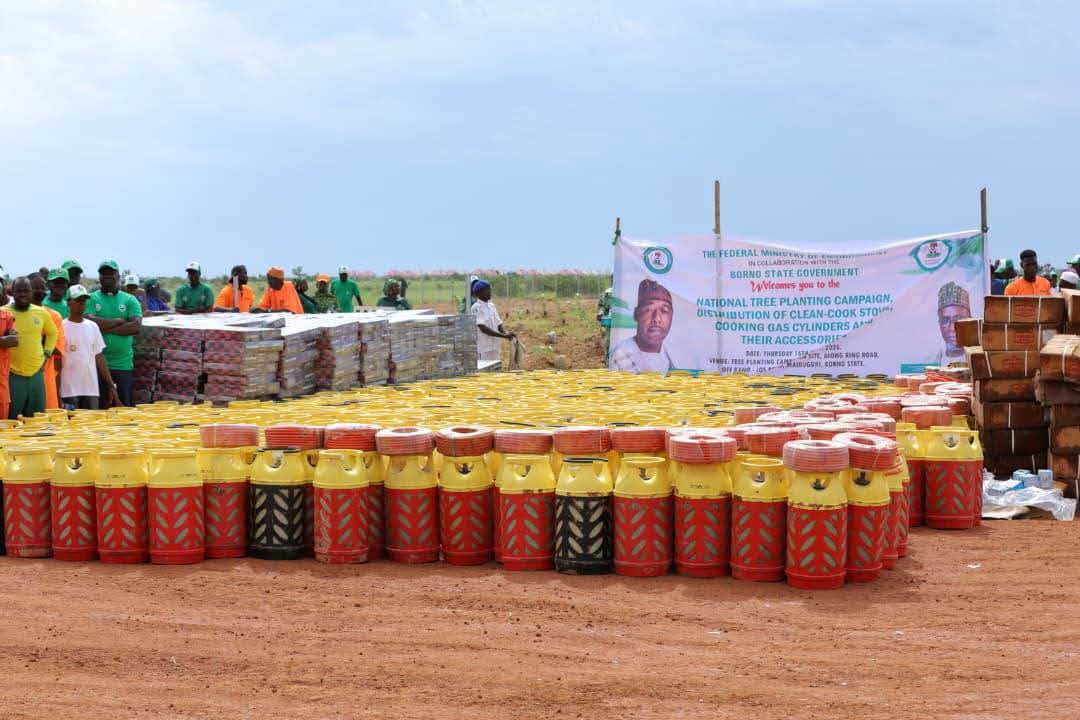
In a move to curb deforestation and promote clean energy, Borno State Governor, Professor Babagana Umara Zulum, has begun the distribution of 23,700 clean cooking gas cylinders to school teachers and environmental vanguards across the state’s 27 local government areas.
Speaking during the flag-off of the programme in Maiduguri, Governor Zulum said the first phase would see 5,000 clean cooking gas cylinders and stoves distributed to teachers and environmental vanguards in Maiduguri Metropolitan Council and Jere Local Government Area, while beneficiaries in the remaining 25 local government areas would receive theirs in subsequent phases.
Read also: Federal Universities Get Green Light to Recruit Staff
BUK Trains Journalists on Earth Observation Tools to Strengthen Climate, Disaster Reporting
The governor added that beneficiaries would also receive refill vouchers to enable them recharge their gas cylinders through designated vendors.
According to him, the initiative is aimed at reducing dependence on firewood, improving household health, protecting forests, lowering carbon emissions and enhancing the quality of life of residents.

Governor Zulum stressed that environmental restoration remains a key component of his administration’s rebuilding and recovery agenda, noting that sustainable development cannot be achieved without protecting the environment.
Read also: Say No to Vote Buying, Violence, Minister Urges Nigerians
He commended President Bola Ahmed Tinubu for prioritising environmental sustainability under the Renewed Hope Agenda and appreciated the support of the Federal Ministry of Environment and development partners toward building a climate-resilient Borno State.
Flagging off the National Tree Planting Campaign, the Minister of Environment, Malam Balarabe Abbas Lawan, praised Governor Zulum for linking tree planting with the provision of clean cooking alternatives.
The minister described the initiative as an innovative approach to tackling deforestation, noting that replacing firewood with clean cooking gas would significantly reduce pressure on the state’s forests.
He also disclosed that about four million tree seedlings would be planted under the campaign and commended Borno State for planting more than 20 million trees, describing the achievement as a model worthy of emulation by other states.
Read also: Affordable Housing: FG Advances 10,000 Units Across Nigeria
AHIP, CDA Training Transforms Smallholder Farmers with Climate Smart Techniques
The minister urged governments, schools, faith-based organisations, the private sector and citizens to embrace tree planting as a collective responsibility to protect the environment for future generations.