


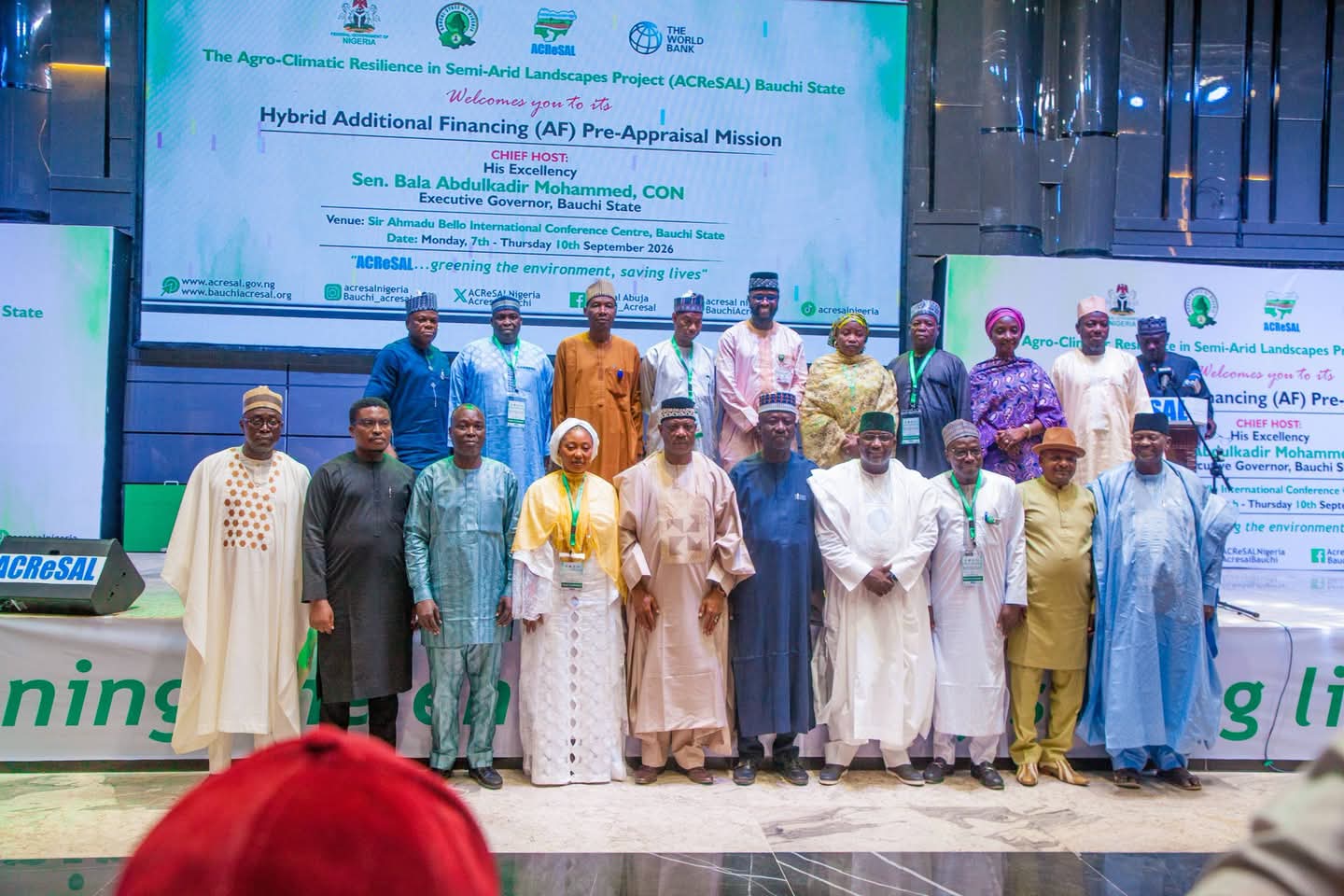
The Agro-Climatic Resilience in Semi-Arid Landscapes, ACReSAL, Project has commenced a Hybrid Additional Financing Pre-Appraisal Mission in Bauchi State, with stakeholders assessing the performance of the project and interventions that could be scaled up under the proposed financing window.
The mission brings together representatives of the World Bank, Federal Project Management Unit, FPMU, Federal and State Ministries, Departments and Agencies, MDAs, as well as State Project Management Units from the 19 Northern States and the Federal Capital Territory.
Read also: Federal Universities Get Green Light to Recruit Staff
Declaring the mission open, Bauchi State Governor, Senator Bala Abdulkadir Mohammed, represented by his Deputy, Rt. Hon. Mohammed Auwal Jatau, pledged the administration’s continued support for climate-resilient agriculture and the restoration of degraded lands across the state.
IITA, ACReSAL Target Stronger Agricultural Value Chains in Katsina
The Deputy Governor described the engagement as an opportunity to strengthen collaboration with the World Bank and other development partners in addressing the challenges posed by climate change, particularly in hard-to-reach communities.
He assured that the state government would provide the required counterpart funding to facilitate successful implementation of the project.
According to him, the proposed additional financing will support the restoration of more than 9,000 hectares of degraded land, strengthen the Ministries of Agriculture, Environment and Water Resources, and expand support to vulnerable communities through youth engagement and the Community Revolving Fund, CRF, scheme.
The ACReSAL Task Team Leader, Dr. Joy Iganya Agene, commended Governor Bala Mohammed for his leadership and understanding of the project, describing Bauchi as one of the leading states under ACReSAL.
Dr. Agene said the push for additional financing was driven by the strong performance recorded by participating states, commending project coordinators and stakeholders for delivering tangible results.
She urged the states to build on the achievements already recorded and strengthen the sustainability of interventions under the proposed financing window.
The National Project Coordinator of ACReSAL, Mr. Abdulhameed Umar, described the project as performing well across participating states, saying this contributed significantly to efforts to secure additional financing.
Read also: Say No to Vote Buying, Violence, Minister Urges Nigerians
He identified Bauchi as one of the best-performing states and explained that it was selected to host the mission because of its visible achievements and tangible projects implemented under ACReSAL.
The Commissioner for Housing and Environment and Chairman of the Bauchi State Steering Committee of ACReSAL, Rt. Hon. Danlami Ahmed Kawule, said the mission was aimed at reviewing the project’s implementation across the participating states and assessing the requirements for accessing additional financing.
He reaffirmed the state government’s commitment to addressing climate change challenges and sustaining the gains recorded under the project.
The Bauchi State ACReSAL Coordinator, Dr. Ibrahim Kabir, explained that the additional financing became necessary following the project’s Mid-Term Review, which indicated that some ongoing interventions might not be completed with the funds initially allocated for the six-year project cycle.
He said the World Bank and participating states subsequently agreed to pursue additional financing based on the project’s performance across the 19 Northern States and the FCT.
Dr. Kabir added that the mission would review previous performance, assess proposals and identify interventions that could be scaled up under the additional financing window.
During the technical session, ACReSAL Co-Task Team Leader, Dr. Mannivel Sene, presented a scorecard on community investment and value-chain development, highlighting measures required to strengthen sustainability and address identified gaps.
Participants also reviewed the criteria for accessing the additional financing, including progress towards establishing coordinating agencies, strengthening institutional sustainability and improving inter-state coordination in the implementation of Strategic Catchment Management Plans, SCMPs.
The stakeholders were informed that the additional financing would be readiness-driven, with implementation expected to commence after the current project cycle is completed in 2028.
Read also: Speaker Commissions Soba Projects to Boost Education, Healthcare
Kano-ACReSAL Participates in Lokoja Strategic Catchment Mission
Participants contributed observations and shared experiences aimed at strengthening project implementation, sustainability and the proposed additional financing framework.