

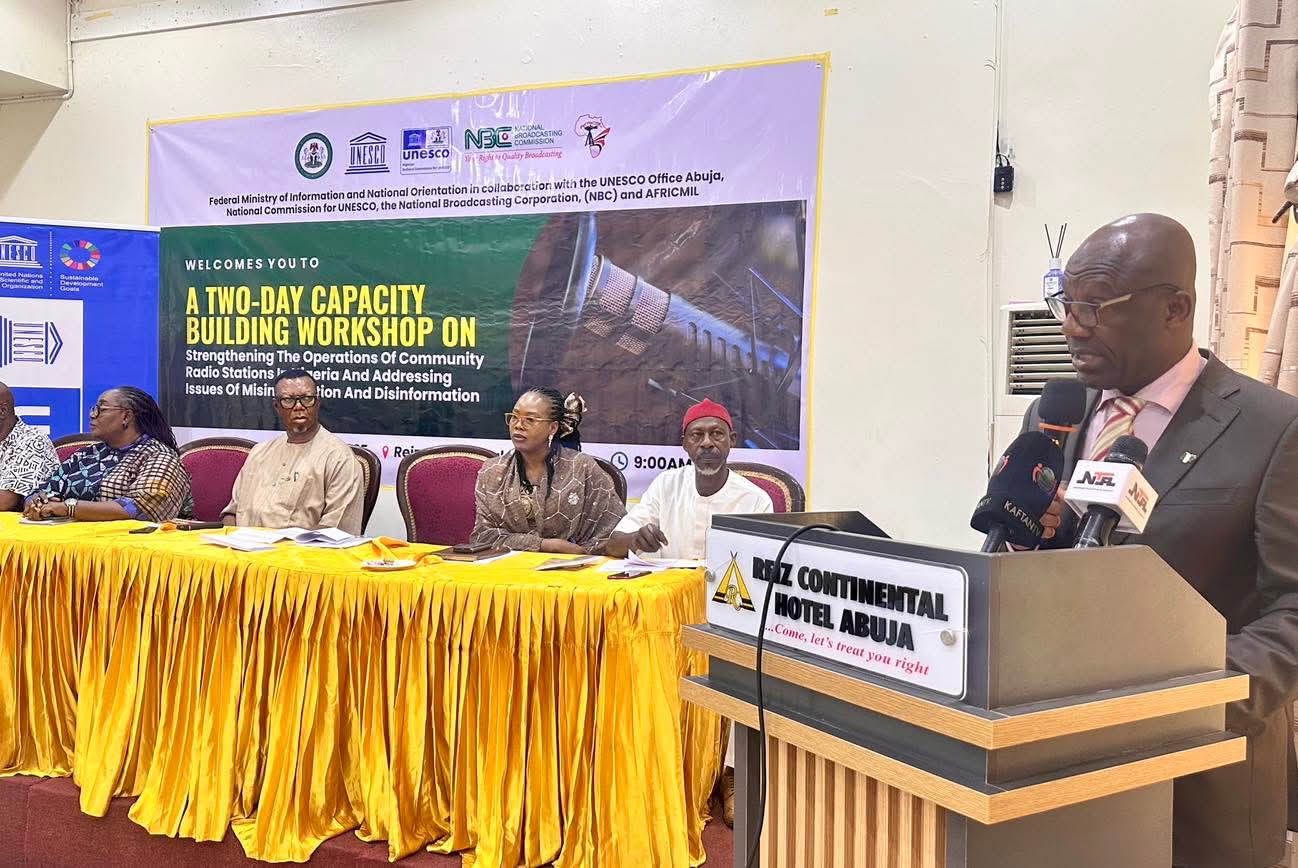
The Minister of Information and National Orientation, Alhaji Mohammed Idris, has reaffirmed the Federal Government’s commitment to strengthening community radio operations as part of a broader strategy to tackle misinformation and promote credible public communication across Nigeria.
Idris made the remarks in Abuja while delivering the keynote address at a two-day workshop on strengthening the capacity of community radio stations.
Read also: Kano Unveils Safe Corridor to End Youth Thuggery,Political Violence
FG Launches IMILI to Boost Media Literacy, Tackle Misinformation
He said the workshop came at a critical time when Nigeria is confronted with an increasingly complex information environment where facts compete with distortions and falsehoods spread rapidly across digital platforms.
“Community radio has never been more essential,” the minister said. “These stations remain the closest and most trusted channels for millions, especially in rural and underserved communities. When community radio thrives, communities thrive — and when it falters, we all feel the consequences.”
Idris noted that community broadcasters play a frontline role in engaging citizens, clarifying issues, debunking rumours, and restoring calm during moments of uncertainty. He said strengthening their capacity aligns with President Bola Ahmed Tinubu’s Renewed Hope Agenda, which prioritises accuracy, integrity, and responsible communication.
According to him, the government is implementing policies to enhance access to finance, improve content development, and make community radio stations more resilient and viable.
Read also: Viewing Centres: The Enduring Home of Nigerian Football Fans
The minister also highlighted a major milestone in Nigeria’s media literacy efforts: UNESCO’s approval of Abuja as host city for the first-ever Category 2 International Media and Information Literacy Institute, located at the National Open University of Nigeria (NOUN).
“This pioneering institute positions Nigeria at the centre of global efforts to confront misinformation and build media-literate societies,” Idris said. “It will serve as a global hub for research, policy innovation, and capacity development.”
He assured participants that the Federal Ministry of Information and National Orientation will continue expanding media literacy initiatives, strengthening regulatory frameworks, and collaborating with development partners to build a safer and more credible information ecosystem.
Idris emphasised that the success of these efforts ultimately depends on the dedication of media practitioners.
“Policies and institutions alone cannot win this battle,” he said. “It lies in the reporters, producers, editors, and volunteers who give life to community radio. The responsibility rests with you to translate the knowledge gained here into stronger editorial judgment, improved fact-checking, and more responsible broadcasting.”
He commended UNESCO, NATCOM, AFRICMIL, and the National Broadcasting Commission (NBC) for their consistent support and partnership in strengthening Nigeria’s media landscape.
Read also: Journalists’ Pay, Healthcare Top Agenda as NUJ Pushes for Media Reform Bill
Misinformation: BA-N organizes training for Zonal Info. Officers
As the workshop commenced, Idris urged participants to engage fully: “Ask questions, challenge assumptions, build networks, and commit to elevating the quality of information that reaches your communities. Together, we can build a more informed citizenry and a more resilient nation.”