


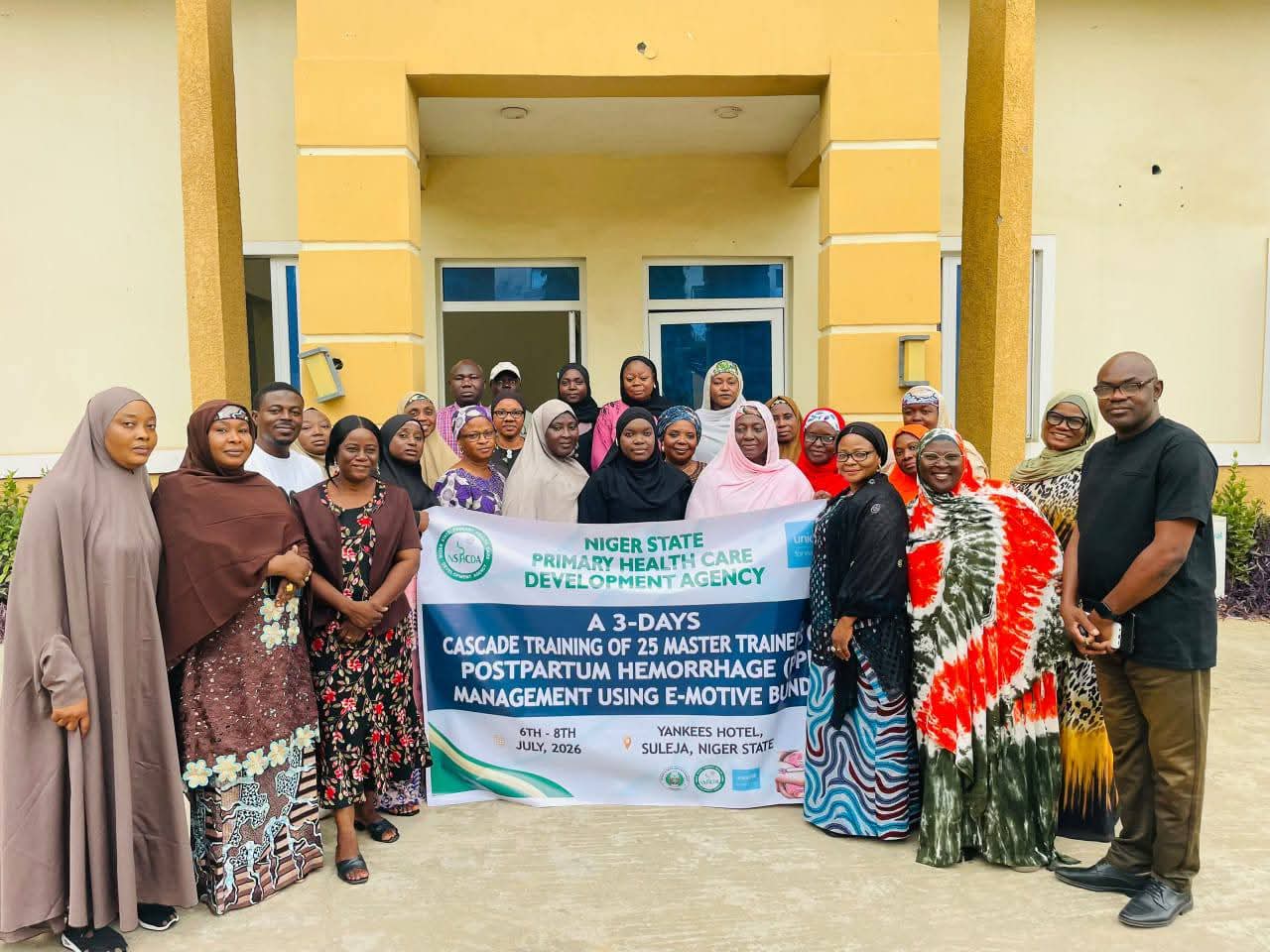
The Niger State Primary Health Care Development Agency (NSPHCDA) has trained 125 healthcare workers on the prevention and management of postpartum haemorrhage (PPH), as part of efforts to reduce maternal mortality and improve the quality of maternal healthcare across the state.
The training began with a three-day Residential Training of Trainers (ToT) on Postpartum Haemorrhage Management using the World Health Organization (WHO)-recommended E-MOTIVE Bundle.
Read also: Lagos Upgrades Yaba Centre for Medical Training
MNCNH Champions Empowered to Reduce Deaths from Postpartum Hemorrhage
Speaking on behalf of the Executive Director of the Agency, Dr. Junaidu Inuwa, the Director of Community Health Services, Dr. Abdulsalam Ahmed, reaffirmed the agency’s commitment to improving maternal and newborn health through continuous capacity building for healthcare workers.
The initial training brought together 25 Master Trainers, including obstetricians, medical officers, nurses, midwives, reproductive health coordinators, tutors from schools of nursing and midwifery, as well as monitoring and evaluation officers from across the state.

The State Reproductive Health Coordinator, Fatima Gogo Mohammed, said the programme was designed to equip participants with the knowledge and practical skills required to prevent, promptly identify and effectively manage postpartum haemorrhage using the E-MOTIVE Bundle.
Read also: Beyond Connectivity: How a Community Network Is Changing Life in Dakwa
She explained that participants received both theoretical and hands-on training in blood loss measurement, early recognition of danger signs, administration of uterotonic drugs and Tranexamic Acid (TXA), intravenous fluid resuscitation, referral protocols, Basic Emergency Obstetric and Newborn Care (BEmONC), infection prevention and control, and adult learning methodologies to enable them train other healthcare providers.
Following the completion of the Master Trainers’ programme, the Agency commenced a three-day step-down training for 100 frontline healthcare providers drawn from the 25 Local Government Areas of the state.
According to the Agency, the exercise is intended to cascade the knowledge and skills acquired by the Master Trainers to healthcare workers at primary healthcare facilities, ensuring that quality postpartum haemorrhage management is strengthened across all 25 local government areas.
The NSPHCDA expressed confidence that the training would significantly enhance the capacity of healthcare workers to respond effectively to postpartum haemorrhage, one of the leading causes of maternal deaths in Nigeria.
Read also: Kebbi 2027: ADC Reps Aspirant, Hundreds Join APC
Kano Records 50% Drop in Maternal Mortality Through AEARI Innovations
The Agency noted that the initiative aligns with the New Niger Health Agenda, which seeks to improve access to quality, evidence-based maternal and newborn healthcare services across the state.