


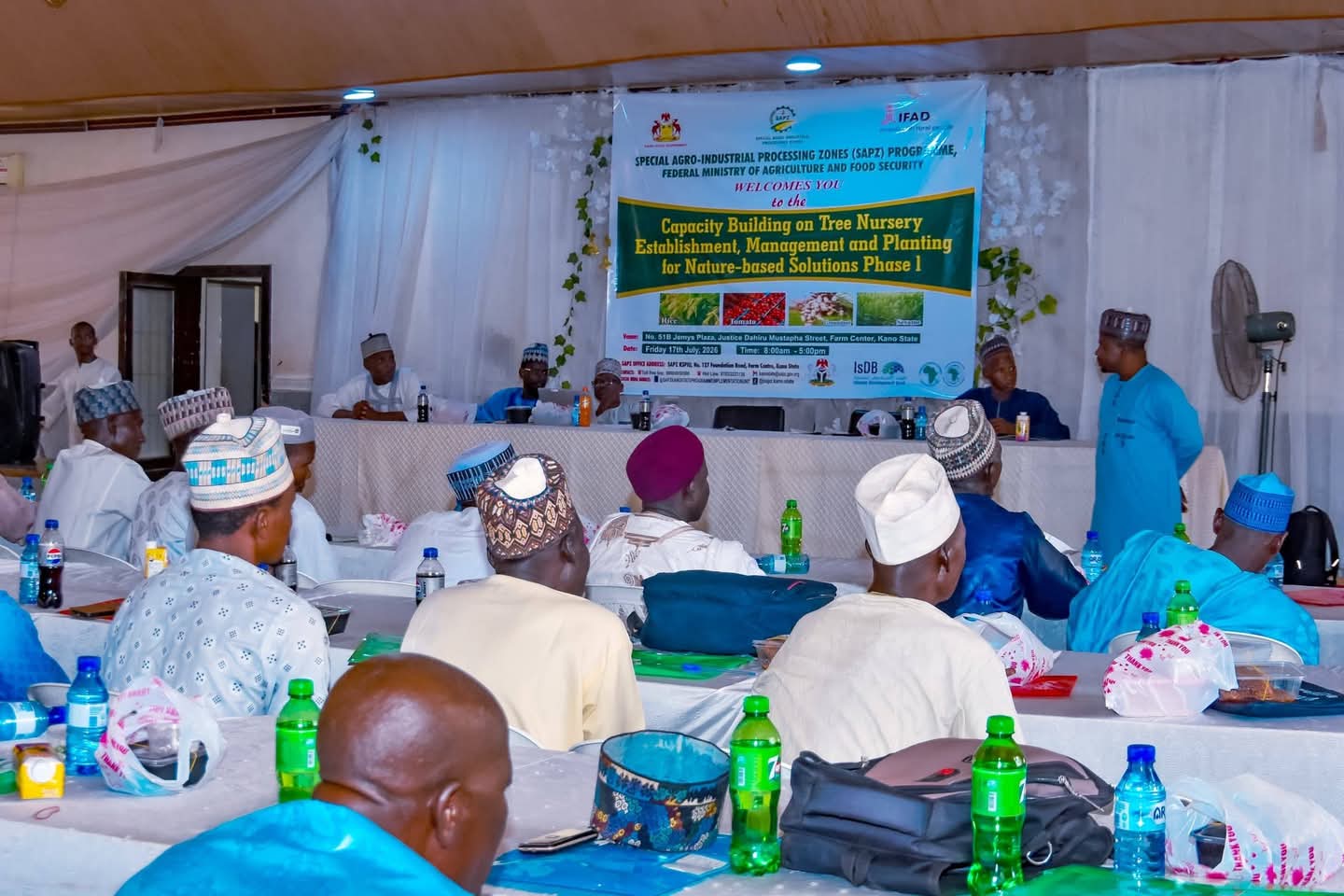
The Special Agro-Industrial Processing Zones (SAPZ) Programme in Kano State has conducted a capacity-building programme on tree establishment, management and planting as part of efforts to promote climate-smart agriculture and environmental sustainability.
The training, brought together key stakeholders to strengthen their knowledge and practical skills in sustainable tree establishment, management and the application of nature-based solutions to address climate change.
Read also: AMG Foundation Honors Exceptional Health Professionals in Kano
The programme focused on equipping participants with practical skills in tree planting techniques, nursery establishment and management, post-planting care, species selection and sustainable land restoration practices.
Participants were also trained on integrating trees into agricultural landscapes to improve soil fertility, conserve biodiversity, reduce land degradation, enhance carbon sequestration and build the resilience of farming communities against the impacts of climate change.
Read also: New Commissioner Vows to Transform Kano’s Environment

Speaking during the training, the Environmental and Climate Change Officer of the SAPZ Programme Kano State Project Implementation Unit (KSPIU), Dr. Kabir Ya’u Abdullahi, described nature-based solutions as one of the most cost-effective and sustainable approaches to restoring degraded ecosystems, improving environmental health and increasing agricultural productivity.
He urged participants to champion tree planting initiatives in their respective communities and institutions to support the state’s efforts towards building a greener and more climate-resilient environment.
Read also: Taraba Strengthens PHCs, Deploys Ambulances to 16 LGAs
Dr. Abdullahi said the initiative forms part of the SAPZ Programme’s broader environmental and climate change interventions aimed at promoting sustainable natural resource management while supporting inclusive agro-industrial development across participating local government areas in Kano State.
He added that the first phase of the training would be followed by subsequent phases designed to further strengthen stakeholders’ capacities and accelerate the adoption of nature-based solutions in the implementation of the SAPZ Programme.