


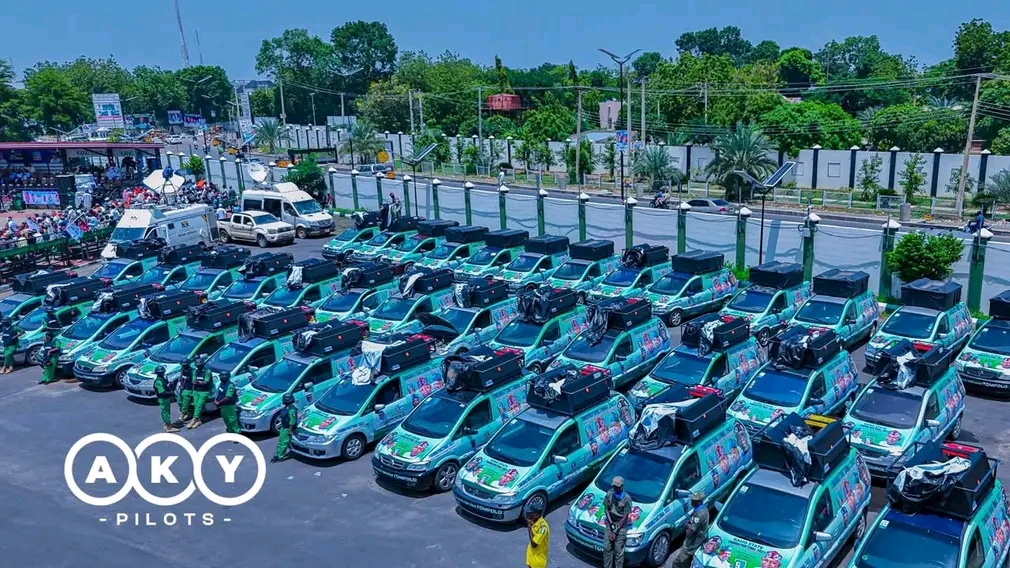
As the political landscape ahead of Nigeria’s 2027 general elections begins to take shape, Kano State has witnessed another significant mobilisation of the All Progressives Congress (APC), with Governor Abba Kabir Yusuf flagging off the distribution of 50 branded campaign vehicles to support grassroots operations.
The vehicles were donated by High Chief Government Ekpemupolo, popularly known as Tompolo, founder and convener of the PBAT Door-to-Door Movement, a political mobilisation platform established to canvass support for President Bola Ahmed Tinubu’s re-election.
Read also: Kurmawa Cholera Outbreak: Two Dead as KNCDC Deploys Emergency Support
The Kano event brings the movement’s expanding northern mobilisation effort to another major political centre. The group had earlier launched its northern campaign structure in Katsina, where vehicles were also distributed to coordinators across the state’s 34 local government areas.
Governor Yusuf, who formally received the vehicles on behalf of the APC in Kano, described the donation as a demonstration of what he called commitment, loyalty and confidence in the leadership of the party and the Tinubu administration.
According to him, the vehicles would be deployed across Kano’s 44 local government areas to strengthen the party’s structures and facilitate grassroots mobilisation ahead of the elections.

For Kano, the event carries additional political significance. Governor Yusuf returned to the APC in January 2026 after leaving the New Nigeria People’s Party (NNPP), the platform on which he was elected governor in 2023. The Kano State Government said at the time that the decision followed consultations and was intended to align the state with the federal ruling party.
Since then, the governor and APC leaders in the state have increasingly focused on consolidating the party’s structures ahead of 2027. In May, the APC cleared Yusuf to seek a second term as governor, with the party saying he had satisfied the requirements for the nomination.
But beyond the vehicles and political structures, the Kano gathering provided Governor Yusuf with a platform to articulate his argument for continuity at the federal level.
He called on Nigerians, particularly voters in the North-West, to support President Tinubu’s bid for a second term, framing the appeal around an informal understanding over the rotation of presidential power between the North and South.
Yusuf argued that the North had completed eight years under former President Muhammadu Buhari and that the South should, under the same political understanding, be allowed to complete eight years before power returns to the North.
He urged northern voters to exercise what he described as patience until 2031, when, according to his argument, the eight-year period would have been completed.
The governor’s position reflects a broader political argument being advanced by some northern political actors in the build-up to 2027. It remains, however, a political position rather than a constitutional requirement, as Nigeria’s Constitution does not prescribe an eight-year North-South rotation of the presidency.
Representing Tompolo at the Kano event, Delta State House of Assembly Speaker, Emomotimi Dennis Guwor, said the PBAT Door-to-Door Movement was expanding its structures across the country to take its campaign directly to communities.
Tompolo, according to his representative, believes that the economic reforms of the Tinubu administration, including the removal of fuel subsidy, foreign exchange reforms and infrastructure development, are attracting increasing public support.
The movement specifically pointed to infrastructure projects in northern Nigeria, including the Kano rail project, the Ajaokuta-Kaduna-Kano (AKK) gas project and the rehabilitation of the Mallam Aminu Kano International Airport, as examples of developments it associates with the Federal Government’s agenda.
The movement plans to establish structures at state, local government and unit levels, with its central strategy built around direct engagement with voters.
Read also: Tompolo Expresses Confidence in Tinubu’s Economic Reforms, Projects 70% Votes in 2027
“Every door will be knocked and every home will be reached,” Guwor quoted Tompolo as saying, underscoring the movement’s emphasis on household-level mobilisation.
That strategy is already being rolled out in several states. In Katsina, the movement inaugurated coordinators across the 34 local government areas during its northern launch earlier in September. In Borno, it subsequently unveiled 44 vehicles and other campaign equipment for mobilisation across the state’s 27 local government areas.
The Kano deployment therefore represents another step in an increasingly organised campaign to build a nationwide grassroots network ahead of 2027.
The choice of a door-to-door strategy reflects an attempt to take political messaging beyond rallies and large gatherings and into neighbourhoods, communities and individual households.
The movement was formally launched nationally in Abuja in July, where its leadership described the initiative as a vehicle for grassroots mobilisation and wider political engagement ahead of the 2027 presidential election.
Its campaign model is centred on establishing coordinators and support structures at increasingly local levels, allowing campaign messages to be carried directly to voters.
For the APC in Kano, the availability of dedicated vehicles could provide logistical support for that mobilisation effort, particularly across the state’s extensive network of local government areas and wards.
Governor Yusuf also used the occasion to call for peaceful and issue-based political campaigns.
He urged political parties and their supporters to avoid violence, criminality and character assassination, arguing that politicians should instead tell voters what they have done in office and what they intend to do if elected.
His appeal places emphasis on the substance of political campaigns at a time when parties and political movements are beginning to intensify preparations for the 2027 elections.
While speaking through the Delta Assembly Speaker, Tompolo set an ambitious target for the movement, saying he expected President Tinubu to secure at least 70 per cent of the votes cast across the country in the 2027 presidential election.
The claim was reported at the Kano event and represents the movement’s stated campaign objective, rather than an established electoral outcome.
The target illustrates the scale of ambition behind the door-to-door campaign as it moves beyond its initial organisational phase.
For Governor Yusuf, meanwhile, the Kano event was an opportunity to reinforce his administration’s alignment with the APC at the federal level and to rally party members around the 2027 elections.
He expressed confidence in the party’s prospects and called on its members to remain united, peaceful and focused on their political objectives.
Read also: Kano’s Education Reforms Boost NECO Performance-KSAFE
As the countdown to 2027 continues, the distribution of the 50 vehicles is more than a ceremonial handover. It is a visible sign of a campaign infrastructure being assembled ahead of a contest in which political parties, support groups and individual actors are already positioning themselves for influence at the grassroots.
And in Kano—a state with a large electorate and a long history of competitive politics—the ability to translate political structures, vehicles and campaign promises into sustained engagement with voters will form an important part of the contest that lies ahead.