


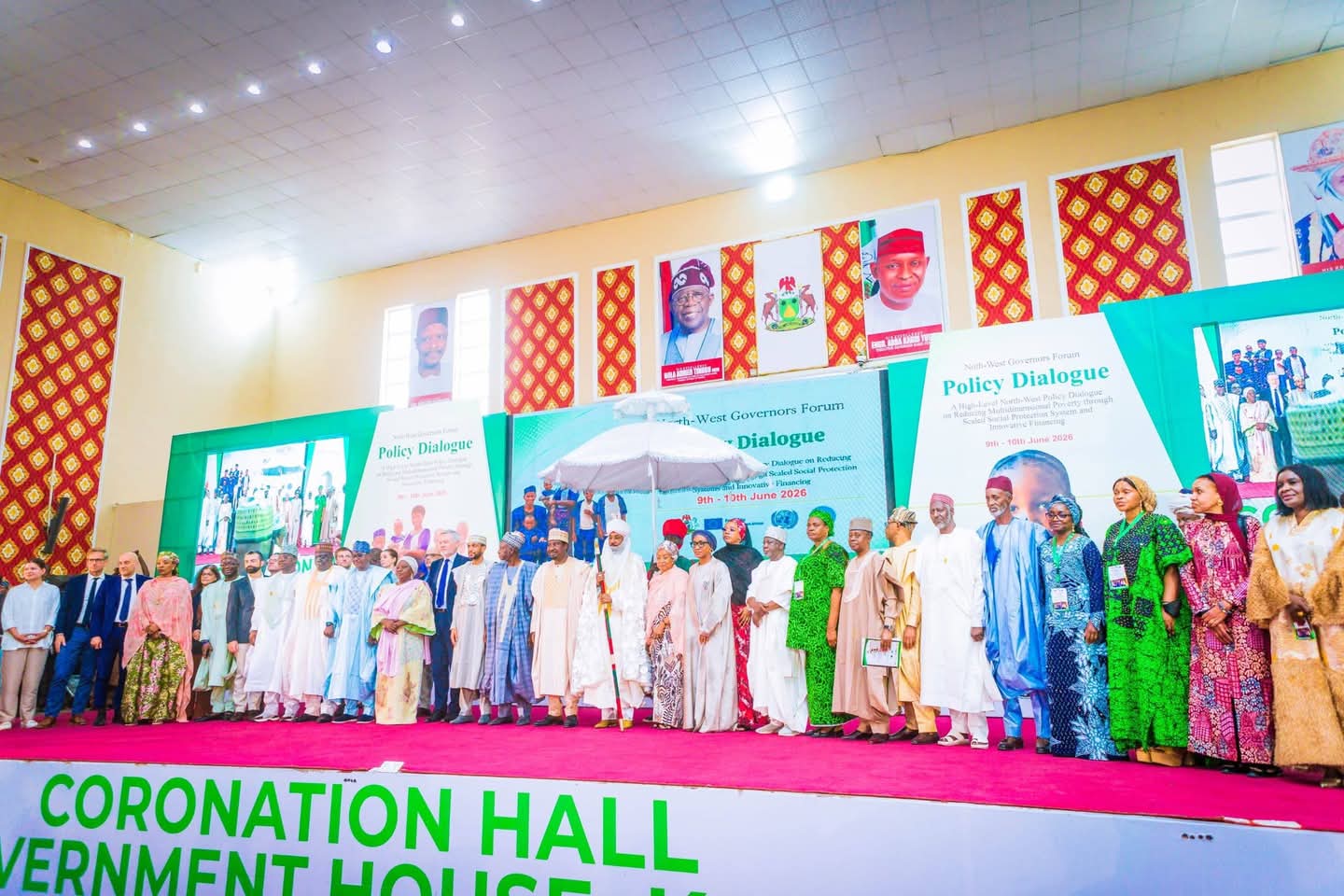
The Federal Government has reaffirmed its commitment to working with state governments, traditional institutions, religious leaders, communities, and development partners to build a credible, scalable, and sustainable social protection system in line with President Bola Ahmed Tinubu’s Renewed Hope Agenda.
Vice President Kashim Shettima made this known during the North-West Governors’ Forum (NWGF) Policy Dialogue on Reducing Multidimensional Poverty Through Scaled Social Protection Systems and Innovative Financing held in Kano.
Read also: Kano Moves to Fill Vacancies with Six Commissioner Nominees
Represented by the Deputy President of the Senate, Barau Jibrin, the Vice President described social protection as a critical pillar of national development and a key responsibility of government.
According to him, social protection serves as an instrument for preventing vulnerability from degenerating into destitution and ensures that the poorest citizens are not left behind due to circumstances such as poverty, conflict, climate challenges, geography, or economic shocks.
He stressed the need for Nigeria to move beyond fragmented interventions and establish durable systems supported by a credible social register, transparent payment mechanisms, efficient service delivery structures, and sustainable financing models capable of withstanding political transitions.

Shettima noted that the North-West region occupies a strategic position in Nigeria’s development, describing it as a demographic and economic powerhouse with immense agricultural, commercial, industrial, and entrepreneurial potential.
“The North-West remains central to Nigeria’s destiny. It is home to vast agricultural opportunities, thriving commerce, youthful energy, and distinguished entrepreneurs who continue to contribute significantly to the nation’s economy,” he said.
However, he acknowledged the challenges facing the region, including poor health and education indicators, widespread poverty, and high rates of child malnutrition.
“We inherited significant deprivations across health, education, nutrition, and income security. More than eight million children remain out of school, maternal mortality rates are still alarming, under-five mortality remains unacceptably high, and child stunting affects over half of children in some communities,”
In his remarks, Chairman of the North-West Governors’ Forum and Governor of Katsina State, Dikko Umaru Radda, represented by his deputy, Faruk Lawal Jobe, described poverty reduction as a strategic investment for the region’s future.
He stated that the policy dialogue and its recommendations would contribute significantly to strengthening critical sectors such as healthcare, education, agriculture, and security, thereby improving the well-being of citizens across the North-West.
Read also: NDLEA Arrests 1,860 Suspects, Seizes 5.4 Tonnes of Drugs in Kano
Earlier, Governor of Kano State, Abba Kabir Yusuf, represented by Deputy Governor Murtala Sule Garo emphasized the collective responsibility of leaders and stakeholders to ensure that policies and investments translate into tangible improvements in the lives of citizens.
He noted that special attention must be given to women, children, youth, persons with disabilities, and other vulnerable groups.
The governor expressed confidence that the deliberations from the forum would generate actionable recommendations capable of fostering a more inclusive and prosperous future for the North-West and Nigeria as a whole.
Speaking at the event, UNICEF Country Representative in Nigeria, Wafaa Saeed Abdelatef, reiterated the organization’s commitment to supporting Nigeria’s efforts to improve the lives of children.
She highlighted the importance of the North-West region, noting that one in every four Nigerian children lives in the zone, making progress in the region essential for national and continental development.
According to her, Nigeria’s success in addressing child poverty and vulnerability would have far-reaching implications for Africa and the global community.
She further emphasized that social protection systems are crucial in helping communities withstand economic, security, and climate-related shocks, enabling families to remain resilient and avoid negative coping mechanisms during crises.
“Social protection is about building systems that help people and communities become resilient in the face of insecurity, economic hardship, and climate shocks,” she said.
The
Read also: ACReSAL: Kebbi Moves to Tackle Erosion in Vulnerable Communities
The policy dialogue attracted high-level participation from government officials, development partners, and traditional leaders, including the Director-General of the North-West Governors’ Forum, Maryam Musa Yahaya; the EU Ambassador to Nigeria Gautier Mignot; deputy governors from Jigawa, Sokoto, and Kaduna states; and the Emir of Kano, Muhammadu Sanusi II.
The dialogue focused on developing practical strategies and innovative financing mechanisms to reduce multidimensional poverty and strengthen social protection systems across the North-West region.