


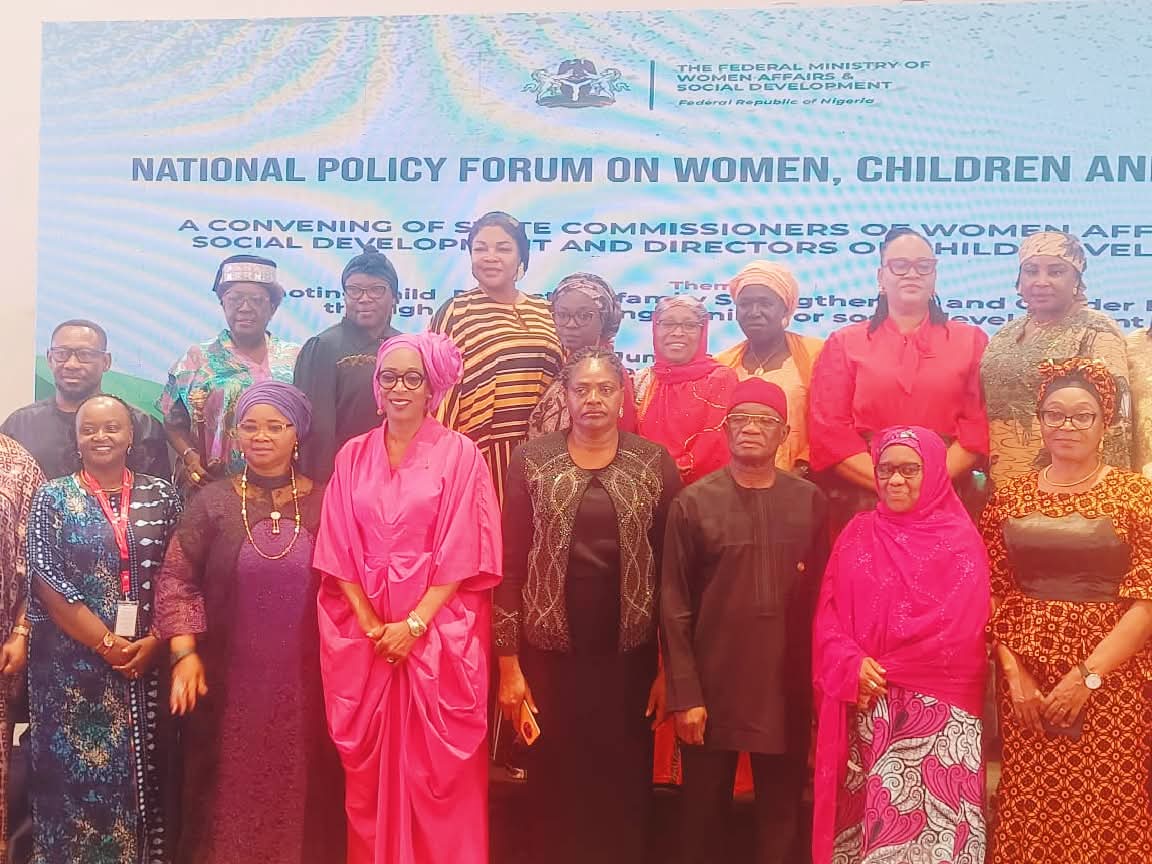
The Federal Ministry of Women Affairs and Social Development has convened a high-level meeting of State Commissioners for Women Affairs and Social Development, development partners, and other key stakeholders to review and validate Nigeria’s periodic reports to the United Nations Committee on the Rights of the Child, alongside several strategic policy documents aimed at strengthening protection systems for women, children, families, and vulnerable groups.
The four-day meeting, taking place at the Abuja Continental Hotel, focuses on reviewing and validating critical national policy instruments, including the Draft 5th–8th Combined Periodic Reports on the Rights of the Child, the 2007 National Child Policy, the Child Protection and Child Well-being Index, Guidelines for the Re-certification of Child Adoption Services, the Global Charter on Children’s Care Reform, and other frameworks designed to improve service delivery and protection outcomes nationwide.
Read also: Speaker Commissions Soba Projects to Boost Education, Healthcare
Speaking on behalf of the Minister of Women Affairs and Social Development, Imaan Suleiman-Ibrahim, the Permanent Secretary of the Ministry, Esuabana Nko Asanye, described the gathering as a demonstration of the Federal Government’s commitment to fulfilling its national and international obligations regarding the welfare and protection of women, children, families, and vulnerable populations.
NWGF Launches Regional Plan to Re-Enrol 781,000 Out-of-School Children
“This meeting highlights the Federal Government’s unwavering commitment to promoting and protecting the rights and welfare of women, children, vulnerable groups and families in line with our national priorities and international obligations,” she stated.
Mrs. Asanye emphasized the strategic importance of the documents under review, noting that they would guide future interventions, strengthen protection systems, and improve service delivery across the country.
She urged participants to contribute actively by providing recommendations and insights that reflect the realities and priorities of communities across Nigeria.
The meeting is expected to strengthen collaboration among federal and state governments, development partners, civil society organisations, and child-focused institutions while generating actionable recommendations to enhance child protection systems, social welfare services, family-based care, accountability, and policy responsiveness to emerging social challenges.
Delivering a goodwill message on behalf of UNICEF Nigeria, Mona Aika commended the Ministry for convening the forum at a crucial period when Nigeria is intensifying efforts to strengthen systems that protect children and support families.
She stressed the need for policies to translate into practical services that reach communities and ensure that children and families have access to support whenever protection concerns arise.
Aika reaffirmed UNICEF’s commitment to supporting government-led efforts to build an inclusive, coordinated, and accountable social development system that leaves no vulnerable person behind.
Read also: Affordable Housing: FG Advances 10,000 Units Across Nigeria
Also speaking, Jane Mbagi Mutua, representing Save the Children International Nigeria, praised the Ministry’s leadership in advancing child rights reforms and called for greater commitment to translating policies into measurable outcomes.
According to her, despite progress made in child protection, millions of Nigerian children continue to face violence, abuse, neglect, poverty, displacement, climate-related challenges, and emerging digital threats.
She identified child participation, evidence-based policymaking, strengthening the social service workforce, promoting family-based care, and responding to emerging risks as priority areas requiring urgent attention.
“The true measure of our progress will not be the policies we produce, but the lives we change,” she said.
Mutua also commended ongoing efforts by the Ministry to review the National Child Policy, develop a new 2026–2030 Strategic Framework, strengthen adoption and alternative care systems, and establish a Child Protection and Child Well-being Index.
In his remarks, Mark Nwakaudu of SOS Children’s Villages Nigeria applauded the leadership of the Minister of Women Affairs for advancing child protection reforms, particularly the launch of the National Guidelines on Alternative Care for Children in Nigeria in 2025.
He described the initiative as a landmark achievement in protecting children without parental care and those at risk of losing parental care.
Nwakaudu further emphasized the importance of endorsing the Global Charter on Children’s Care Reform, noting that it aligns with Nigeria’s efforts to ensure every child grows up in a safe, nurturing family environment rather than institutional care.
Representing State Commissioners for Women Affairs and Social Development, Amina Abdullahi-Sani called on participants to engage actively in the validation process.
She noted that the outcome of the review would shape future policies affecting women, children, and persons with disabilities while strengthening protection, inclusion, and access to essential services across the country.
Read also: Federal Universities Get Green Light to Recruit Staff
Benue Must Invest in Nutrition to Save Children, UNICEF Warns
Stakeholders at the forum reaffirmed their collective commitment to ensuring that every Nigerian child is protected, every family is supported, and every vulnerable person is given the opportunity to thrive in a safe, inclusive, and equitable society.