


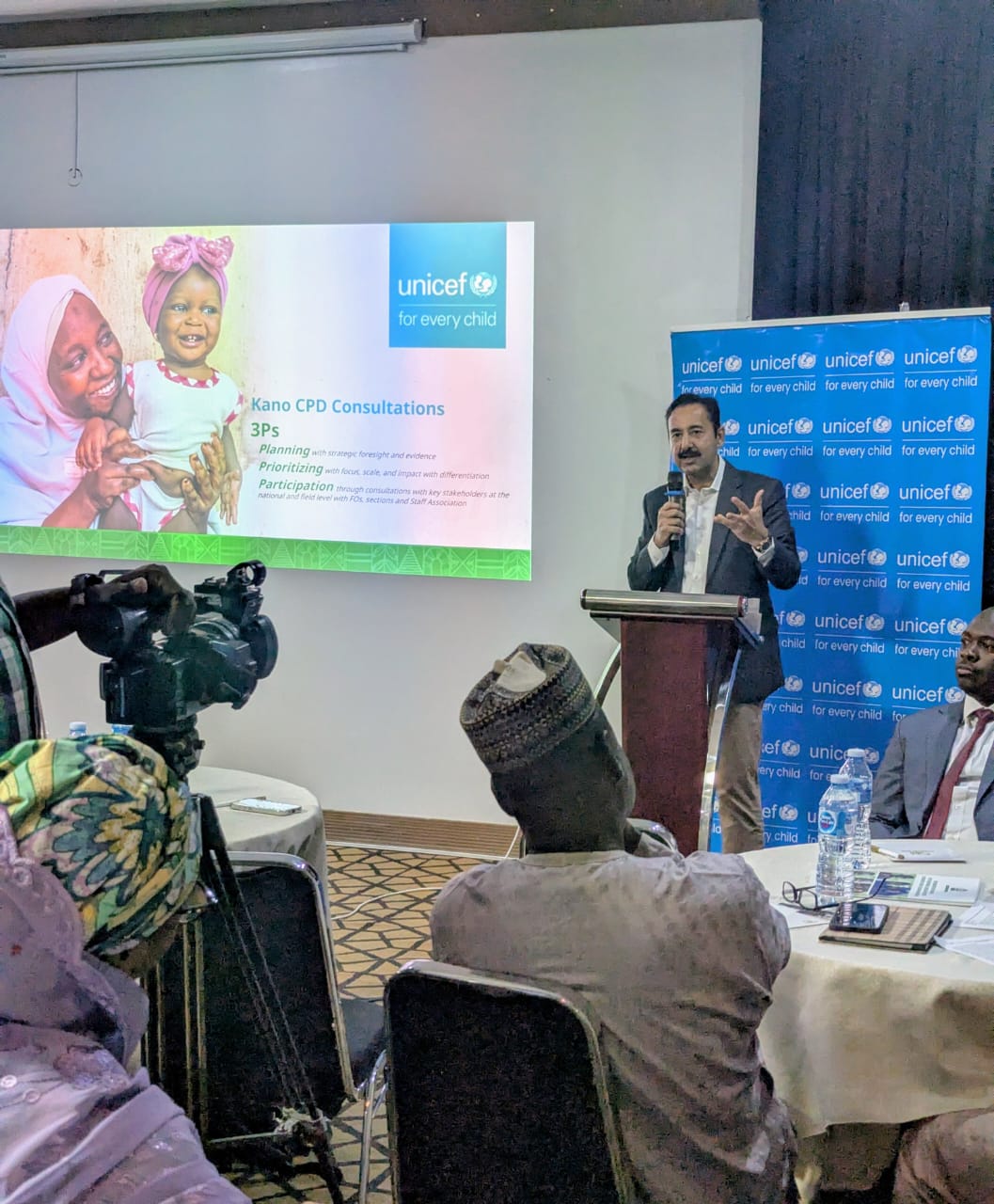
The United Nations Children’s Fund (UNICEF) has urged governments and relevant stakeholders to adopt a multisectoral approach to addressing issues affecting children, stressing that challenges confronting children are interconnected and require coordinated interventions across education, health, nutrition, child protection, social protection, water, sanitation and hygiene (WASH), climate resilience, and governance.
The call was made by the Chief of UNICEF Kano Field Office, Shafeeq Ur-Rehman, during the Kano Field Office consultation on the development of the Federal Government of Nigeria/UNICEF Country Programme Document (CPD) 2028–2032, which brought together stakeholders from Kano, Jigawa and Katsina States.
Read also: Affordable Housing: FG Advances 10,000 Units Across Nigeria
Benue Must Invest in Nutrition to Save Children, UNICEF Warns
Ur-Rehman described the consultation as a critical step towards designing UNICEF’s next five-year Country Programme, noting that it was his first major engagement with partners since assuming duty in Kano. He said the exercise was aimed at ensuring that the new programme reflects the priorities of state governments and aligns with their development plans, sector strategies and the aspirations of communities.
He commended the governments of Kano, Jigawa and Katsina States for their continued partnership with UNICEF and their commitment to improving the lives of children, emphasizing that sustainable development outcomes can only be achieved through strong government leadership, broad partnerships and collective ownership.
According to him, the next Country Programme is being developed at a time when children are facing increasingly complex challenges driven by rapid population growth, urbanisation, climate-related shocks, technological transformation, economic pressures, insecurity and changing social realities.
He explained that the 2028–2032 Country Programme must be responsive to the most pressing deprivations affecting children while remaining flexible, innovative and resilient enough to tackle emerging challenges over the coming years.
Ur-Rehman said the consultation was expected to build a shared understanding of the critical child rights issues affecting Kano, Jigawa and Katsina States, identify systemic bottlenecks, explore innovative and scalable solutions, and generate strategic recommendations that will shape UNICEF’s future programming in the region.
Read also: Speaker Commissions Soba Projects to Boost Education, Healthcare
He encouraged participants to contribute openly and provide evidence-based recommendations, stressing that the success of the next Country Programme would depend on meaningful collaboration among governments, development partners, civil society organisations and communities.
In his goodwill message, the Acting Permanent Secretary of the Kano State Ministry of Planning and Budget Abdulmumin Ajumawa reaffirmed the state government’s commitment to sustaining its strong partnership with UNICEF in promoting the well-being of children, adolescents and other vulnerable groups.
According to him, child malnutrition, learning poverty, inadequate access to quality healthcare, poor water and sanitation services, child protection concerns, climate-related vulnerabilities and socio-economic inequalities remain major issues requiring coordinated and people-centred responses.
He emphasized the importance of aligning development partners’ interventions with government priorities, noting that effective collaboration depends on evidence-based planning, institutional strengthening, improved resource utilization and sustained investment in programmes that deliver measurable results for children.
The Acting Permanent Secretary commended UNICEF for its longstanding support across critical sectors, including health, nutrition, education, water, sanitation and hygiene, child protection, social policy and emergency response, noting that the collaboration has strengthened government systems and contributed to improved development outcomes.
He said the consultation provides an opportunity to assess previous achievements, review lessons learned and develop practical, innovative and sustainable solutions to the persistent challenges facing children across the Northwest.
Read also: ABU SPESSE-CE Graduates 420 in Sustainability Training
UNICEF Raises Alarm Over Malnutrition, Donates RUTF to Kebbi
The consultation brought together commissioners, permanent secretaries, directors of ministries, departments and agencies, development partners, civil society organisations and other stakeholders from Kano, Jigawa and Katsina States to identify strategic priorities that will guide the implementation of the Federal Government of Nigeria/UNICEF Country Programme Document for 2028–2032.