


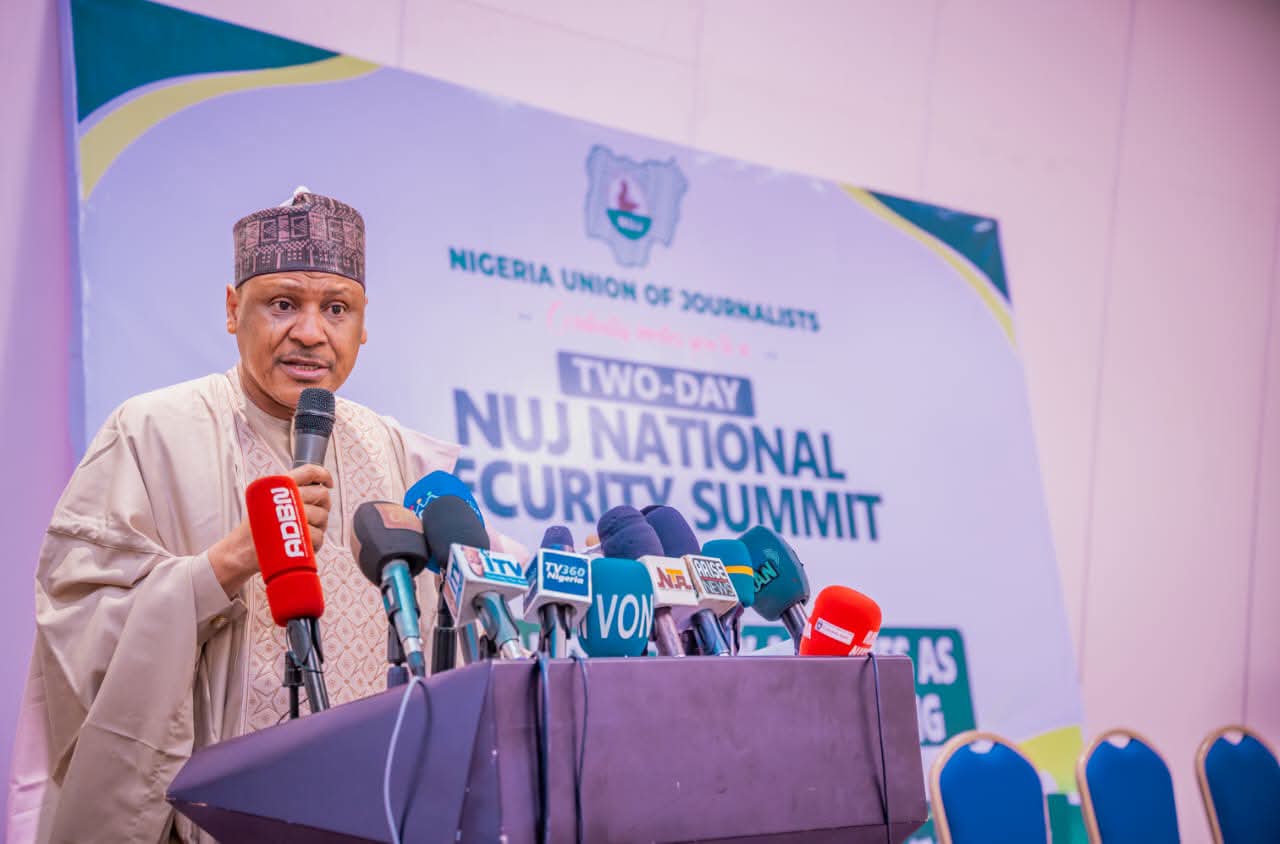
The Minister of Information and National Orientation, Mohammed Idris, has called for deeper collaboration between the media and security agencies, describing the partnership as vital to safeguarding national security, strengthening public trust, and advancing Nigeria’s nation-building efforts.
Idris made the call on Thursday in Abuja while serving as Chairman of the Occasion and Chief Host at the National Security Summit organised by the Nigeria Union of Journalists (NUJ) in collaboration with the Department of State Services (DSS).
Read also: Say No to Vote Buying, Violence, Minister Urges Nigerians
Speaking on the theme, “Media and Security Agencies as Partners in Nation Building,” the Minister said both institutions occupy strategic positions in national development and share a common responsibility of protecting the country’s interests.
According to him, while security agencies are charged with protecting lives, property, and national sovereignty, the media serves as society’s watchdog, a platform for public discourse, and a critical link between government and citizens.
“Both institutions share a common objective: safeguarding the national interest and promoting peace, unity, and development,” Idris stated.
He stressed that collaboration built on mutual respect, professionalism, trust, and an understanding of each institution’s role would significantly strengthen national security and improve public confidence in government institutions.
The Minister observed that Nigeria continues to face increasingly complex security challenges, including terrorism, violent extremism, cybercrime, organised crime, misinformation, and separatist agitations, among other emerging threats.
He noted that the administration of President Bola Ahmed Tinubu has made security a central pillar of its Renewed Hope Agenda through a comprehensive strategy that combines military operations, intelligence gathering, inter-agency cooperation, technological innovation, and community engagement.
“Recognising that no meaningful development can occur without peace and stability, the administration has pursued a comprehensive security strategy that combines military action, intelligence gathering, inter-agency collaboration, technological innovation, and community engagement,” he said.
Highlighting achievements recorded under the current administration, Idris said security agencies have successfully neutralised and arrested terrorists, bandits, kidnappers, and other criminal elements, dismantled criminal hideouts, and rescued hundreds of kidnapped victims across the country.
Read also: Affordable Housing: FG Advances 10,000 Units Across Nigeria
He added that sustained military operations have continued to weaken terrorist groups in the North-East, while intensified efforts against banditry and kidnapping in the North-West and North-Central regions have yielded encouraging results.
The Minister further disclosed that the Federal Government has invested heavily in modern military hardware, intelligence infrastructure, surveillance technology, and capacity-building programmes for security personnel to enhance operational effectiveness and strengthen national security capabilities.
Beyond security operations, Idris said the Tinubu administration remains focused on addressing the root causes of insecurity through economic reforms, youth empowerment initiatives, infrastructure development, educational opportunities, and social intervention programmes aimed at improving citizens’ welfare.
On the role of the media, the Minister underscored the importance of responsible journalism, particularly in an era where misinformation, fake news, and disinformation spread rapidly through digital platforms.
“National security is not served when misinformation is amplified without verification. Neither is it served when legitimate public concerns are ignored. The challenge before us is to strike the right balance between the public’s right to know and the imperative of protecting national security,” he said.
He urged journalists to uphold the highest standards of professionalism, accuracy, fairness, and ethical reporting, while encouraging security agencies to strengthen their engagement with the media through timely, transparent, and credible communication.
Idris assured stakeholders that the Federal Ministry of Information and National Orientation would continue to promote constructive engagement between the media and security institutions through dialogue, strategic communication, public enlightenment campaigns, and capacity-building initiatives.
Describing security as a collective responsibility, the Minister called on citizens, communities, civil society organisations, traditional rulers, religious leaders, and other stakeholders to play active roles in fostering peace, unity, and national development.
He commended the NUJ and DSS for organising the summit and expressed optimism that its deliberations would generate practical recommendations for enhancing cooperation between the media and security agencies.
Read also: ABU SPESSE-CE Graduates 420 in Sustainability Training
The summit attracted senior government officials, security chiefs, media executives, communication professionals, and other stakeholders from across the country.
Among those in attendance were the Director-General of the Voice of Nigeria (VON), Mallam Jibrin Baba Ndace; the Inspector-General of Police, represented by Assistant Inspector-General of Police Miller Dantawaye; the Chairman/Chief Executive Officer of the National Drug Law Enforcement Agency (NDLEA), represented by Assistant Commander-General of Narcotics Dankolo Shehu Mohammed; the President and Chairman of Council of the Nigeria Institute of Public Relations (NIPR), Dr. Ike Neliaku; and the National President of the Nigeria Union of Journalists, Comrade Alhassan Yahaya.SEO Headline: Information Minister Seeks Stronger Media-Security Collaboration to Boost National Security