


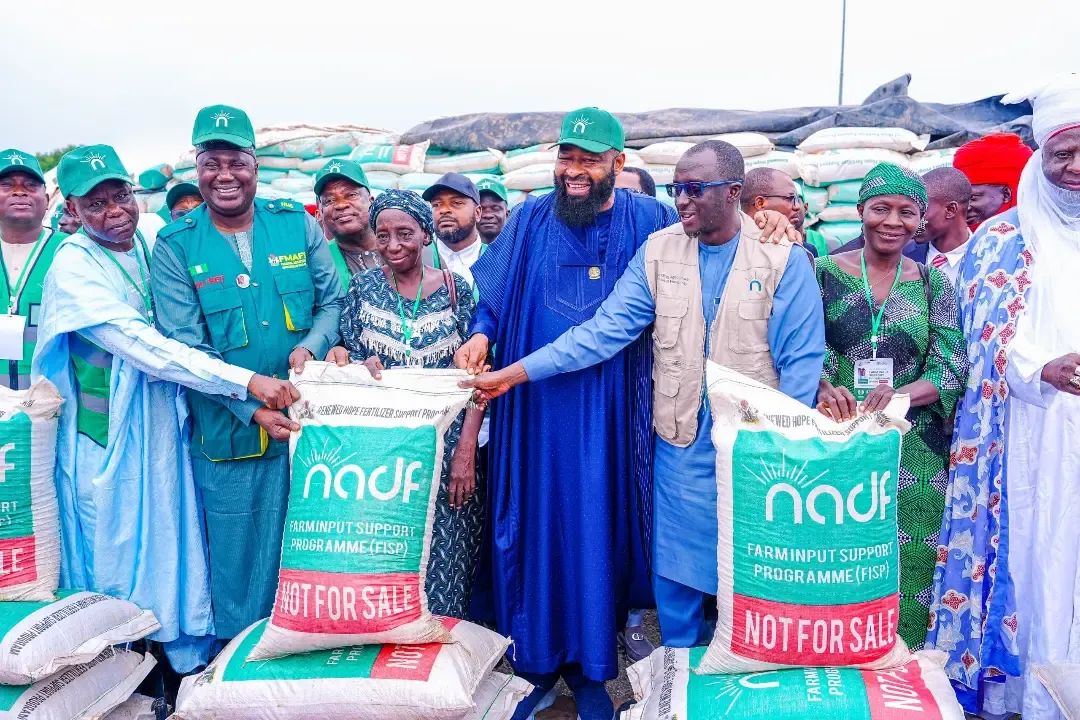
The Federal Government has launched the Farm Input Support Programme (FISP) for the North Central geo-political zone, providing free fertiliser to thousands of smallholder farmers as part of efforts to strengthen food security and boost agricultural productivity across the country.
The programme, initiated by the National Agricultural Development Fund (NADF), was officially flagged off in Minna, Niger State. Under the scheme, 80,640 bags of NPK fertiliser will be distributed free of charge to 20,160 farmers in Niger, Benue, Nasarawa and Kwara states.
Read also: Kaduna LPRES Begins Distribution of 38 Milking Machines
Speaking at the launch, the Executive Secretary and Chief Executive Officer of NADF, Mohammed Abu Ibrahim, described the intervention as a strategic response to one of the major challenges confronting farmers—access to quality and affordable agricultural inputs.
He said the initiative aligns with President Bola Ahmed Tinubu’s Renewed Hope Agenda, which seeks to transform agriculture into a key driver of economic growth, employment generation and national development.
According to Ibrahim, the programme is carefully designed to ensure that support reaches genuine farmers cultivating crops that are critical to Nigeria’s food security objectives and economic prosperity.

“FISP is not fertiliser distribution for the sake of distribution. It is targeted support designed to get fertiliser to the right farmers, for the right crops, at the right time. Our focus is on increasing productivity, improving farm output and supporting a more stable food market,” he stated.
He explained that priority crops were selected in each participating state based on comparative advantage and production potential. In Niger State, the programme targets rice, maize and yam production, while farmers in Benue State will receive support for rice, yam and soybean cultivation.
The NADF chief further disclosed that all fertilisers supplied under the programme are produced locally, fully traceable and clearly branded “Not for Sale” to prevent diversion and ensure accountability throughout the distribution process.
Read also: Kurmawa Cholera Outbreak: Two Dead as KNCDC Deploys Emergency Support
He added that every bag of fertiliser has been linked to verified beneficiaries through a rigorous validation process involving stakeholder consultations, beneficiary screening and data verification mechanisms.
Governor Mohammed Umaru Bago of Niger State commended President Tinubu for prioritising agricultural development, describing the intervention as a practical demonstration of the administration’s commitment to achieving food security and economic prosperity through strategic investments in the sector.
The governor noted that empowering smallholder farmers with critical farm inputs remains one of the most effective approaches to increasing food production, improving rural livelihoods and strengthening agricultural value chains.
Bago also praised the leadership of NADF for its continued support to Nigeria’s agricultural transformation through targeted and innovative programmes that directly impact farmers and rural communities.
Speaking on the sustainability of the initiative, Ibrahim revealed that NADF has established a robust monitoring and evaluation framework to assess productivity levels, measure yield improvements and determine the overall impact of the programme on beneficiaries.
“The real success of this programme will not be measured by today’s ceremony but by what happens on the farms in the coming months. We are committed to tracking results and using evidence to strengthen future interventions,” he said, while urging beneficiaries to use the fertiliser strictly for the intended purpose.
Read also: Ghana Minister Pledges Support for REMAPSEN Forum, Awards
Also speaking at the event, the Minister of State for Agriculture and Food Security, Senator Aliyu Sabi Abdullahi, said the programme underscores the Federal Government’s determination to tackle food insecurity through increased support for farmers.
He noted that the intervention is timely, coinciding with the onset of the rainy season when demand for fertiliser is at its peak, and disclosed that similar programmes would be extended to other parts of the country as efforts continue to enhance agricultural production, food affordability and national food sovereignty.