


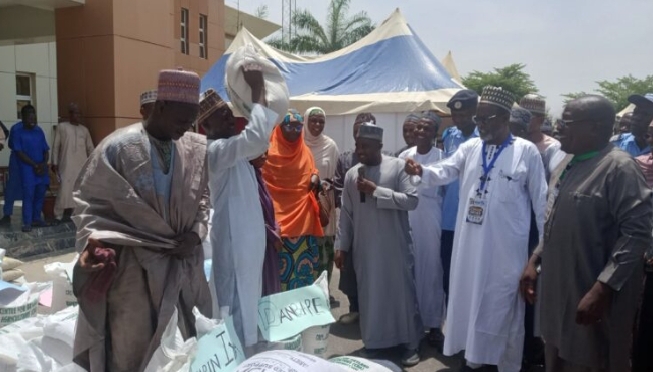
The Centre for Dryland Agriculture (CDA), Bayero University, Kano, has distributed 2.85 tonnes of improved seed varieties to farmers from 22 adopted communities and five additional seed-producing communities as part of efforts to boost agricultural productivity, strengthen food security, and enhance climate resilience in Northern Nigeria.
The distribution took place during the Centre’s 4th Open Day held on Tuesday at Bayero University, Kano.
Read also: Say No to Vote Buying, Violence, Minister Urges Nigerians
The annual event serves as a platform for farmers, researchers, policymakers, development partners, agro-industrial firms, and other stakeholders to exchange knowledge, showcase innovations, and strengthen collaboration in advancing agricultural development.
The improved seeds distributed included cowpea, maize, millet, sorghum, soybean, and rice. Beneficiaries also included junior staff members from the Faculties of Agriculture and Earth and Environmental Sciences, as well as the Centre for Dryland Agriculture, in a move aimed at promoting household food production and improving livelihoods.
Speaking at the event, the Vice-Chancellor of Bayero University, Kano, Professor Haruna Musa, described the Open Day as a strategic platform that bridges the gap between research and practice by connecting scientists, farmers, policymakers, and private-sector actors. He noted that such engagements are critical to translating research findings into practical solutions that address real-world agricultural challenges.
Represented by the Deputy Vice-Chancellor (Academics), Professor Ahmad Muhammad Tsauni, the Vice-Chancellor said the gathering provided an opportunity for stakeholders to share ideas, identify emerging challenges, and develop practical strategies capable of improving agricultural productivity, food security, and sustainable development across Africa.
Professor Musa further commended the Centre for Dryland Agriculture for its remarkable achievements under the Africa Centres of Excellence initiative, noting that the Centre has established itself as a leading hub for research, innovation, capacity building, and technology transfer in dryland agriculture.
Read also: Federal Universities Get Green Light to Recruit Staff
According to him, CDA’s research on improved crop varieties, climate-smart agriculture, soil health management, sustainable farming systems, and agricultural value chains continues to generate innovative solutions capable of transforming agriculture in dryland regions and improving the livelihoods of farming communities.
In his welcome address, the Director of the Centre for Dryland Agriculture, Professor Sanusi Gaya Mohammed, said the Open Day provides a valuable opportunity to demonstrate the impact of the Centre’s research while strengthening the connection between scientific discoveries and practical solutions that improve the lives of farmers and rural communities.
He explained that the seed distribution initiative was designed to increase agricultural productivity, improve household incomes, strengthen food systems, and enhance the capacity of farming communities to cope with the effects of climate variability and climate change. He added that sustainable solutions to food insecurity require strong partnerships among stakeholders.
Professor Mohammed reaffirmed the Centre’s commitment to building strategic collaborations with local and international organizations dedicated to advancing agricultural development and food security. He stressed that collective action remains essential to addressing the growing challenges facing agriculture in dryland regions.
Farmers who benefited from the seed distribution expressed appreciation to the Centre, noting that its interventions have consistently improved farming practices through training, access to improved seed varieties, and modern agricultural techniques, leading to increased productivity, better yields, and enhanced food security in their communities.
Read also: Affordable Housing: FG Advances 10,000 Units Across Nigeria
A major highlight of the Open Day was the research and innovation exhibition, where agro-allied companies showcased a wide range of agricultural products, technologies, and services.
The event attracted several development partners and stakeholders, including the International Crops Research Institute for the Semi-Arid Tropics (ICRISAT), the International Institute of Tropical Agriculture (IITA), the Agro-Climatic Resilience in Semi-Arid Landscapes (ACReSAL) Project, Indorama Fertilizer Company, and the Kano Agricultural and Rural Development Authority (KNARDA).