


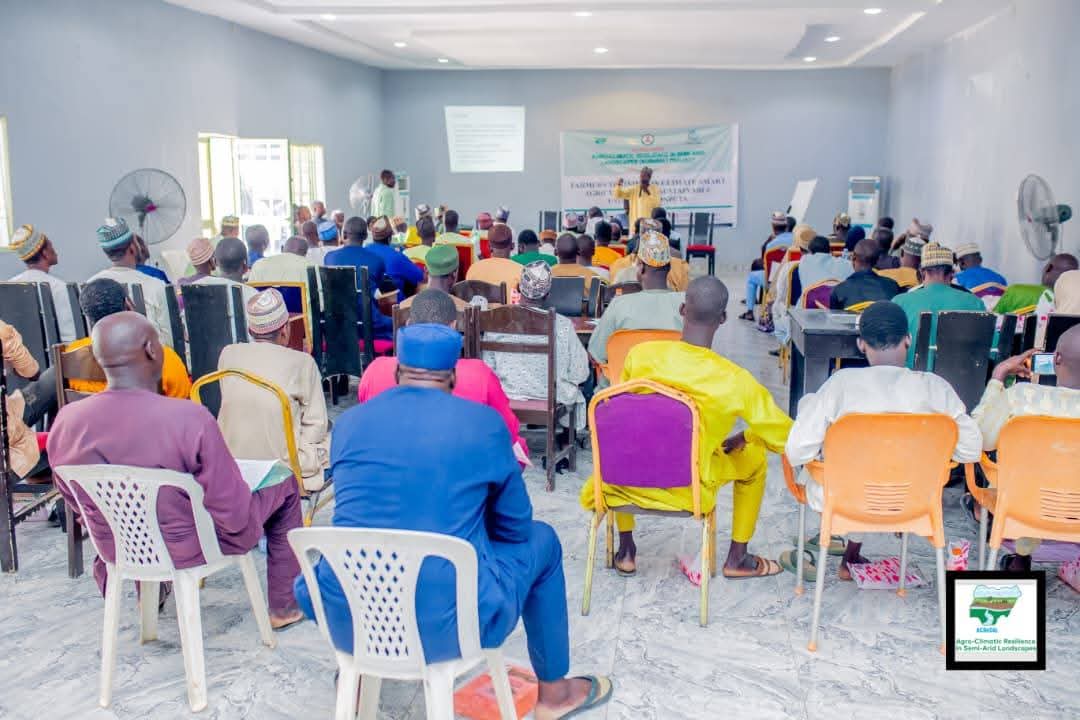
The Katsina Agro-Climatic Resilience in Semi-Arid Landscapes (ACReSAL) Project has organized a training workshop on climate-smart agriculture and the sustainable use of farm inputs for farmers drawn from Katsina, Jibia, and Kaita Local Government Areas.
The workshop, held at the Sahara Suite Hotel in Katsina, brought together farmers, agricultural experts, and members of the State Project Management Unit (SPMU) to enhance farmers’ knowledge and improve agricultural productivity across the state.
Read also: Speaker Commissions Soba Projects to Boost Education, Healthcare
ACReSAL’s Success Sparks Push for Nationwide Institutionalization
Declaring the workshop open, the Katsina ACReSAL Project Coordinator, Alhaji Nafiu Mohammed Musa, said the training was designed to equip beneficiaries with the knowledge and skills needed to maximize the benefits of agricultural support that would soon be distributed by the project.
According to him, the initiative forms part of ACReSAL’s commitment to building agricultural resilience, strengthening food security, and promoting sustainable farming practices in Katsina State.
Musa noted that the project has continued to record significant achievements due to the support and commitment of Governor Dikko Umar Radda, whose administration has provided an enabling environment for the successful implementation of various interventions aimed at improving the livelihoods of farmers and rural communities.
He urged participants to pay close attention to the presentations and apply the knowledge gained to improve their farming activities and productivity.
Read also: ABU SPESSE-CE Graduates 420 in Sustainability Training
Earlier, the project’s Environmental Safeguard Officer and Agricultural Officer, Sanusi Mohammed Faskari, outlined the objectives of the workshop. He explained that the training was organized to educate farmers on modern agricultural techniques that would enable them to adapt to climate change while ensuring the efficient and responsible use of farm inputs such as fertilizers, improved seeds, and agrochemicals.
A resource person from the Katsina State Agricultural and Rural Development Authority (KTARDA), Malam Tanimu Hamza, delivered a presentation on the sustainable use of farm inputs. He stressed the importance of proper application of agricultural inputs to enhance crop yields, reduce wastage, and minimize environmental degradation.
Also speaking, Dr. Ahmed Aliyu of Hassan Usman Katsina Polytechnic presented a paper on climate-smart agriculture, highlighting practical strategies farmers can adopt to cope with changing weather patterns, conserve natural resources, and sustainably increase agricultural productivity.
During an interactive session, Dr. Aminu Sa’idu Ado responded to questions from participants and provided further insights on climate change adaptation, soil management, and best agricultural practices.
Participants actively engaged in discussions, sharing their experiences and challenges in farming across their respective communities. They commended the Katsina ACReSAL Project for organizing the workshop, describing it as timely and impactful.
The farmers expressed confidence that the knowledge acquired would help them improve farming methods, boost productivity, and make more efficient use of agricultural inputs. They also pledged to apply the lessons learned and share the information with other farmers in their communities.
Read also: ABU Honours Onitsha Monarch During Ofala Festival
Kano-ACReSAL Advocates Climate Action in Secondary Schools
The training underscores ACReSAL’s ongoing efforts to promote sustainable agriculture and strengthen the resilience of farming communities against the challenges posed by climate change.