


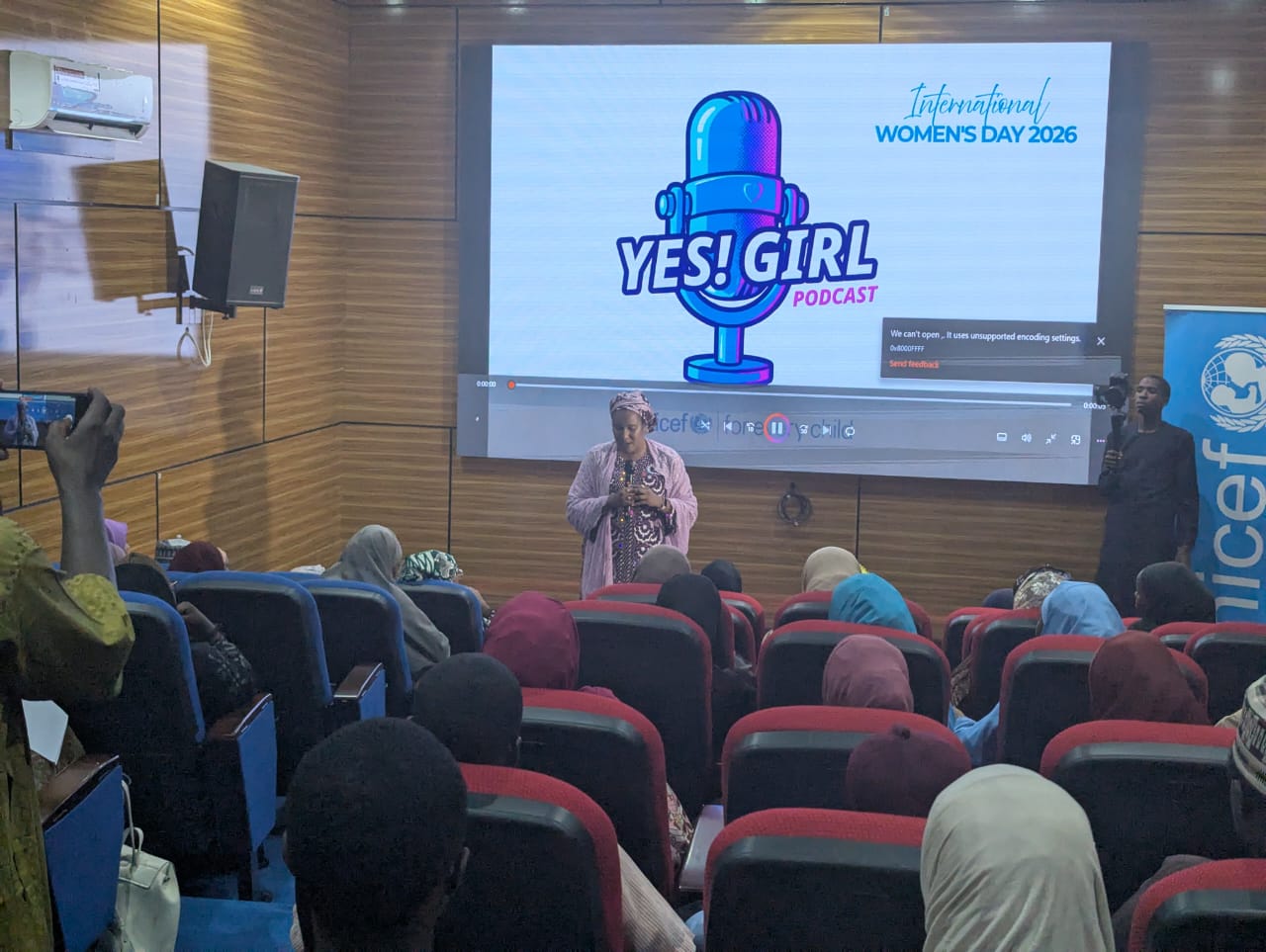
The United Nations Children’s Fund (UNICEF) in collaboration with partners has organized a “Yes! Girl” Podcast Watch Session in Kano as part of activities marking the 2026 International Women’s Day.
The session brought together adolescent girls, government partners, civil society organizations (CSOs), and members of the media to listen directly to girls’ voices, reflect on their experiences, and explore solutions aimed at strengthening their rights, wellbeing, and leadership.
Read also: Speaker Commissions Soba Projects to Boost Education, Healthcare
FG, UNICEF Launch $406,000 Solar Vaccine Storage in Borno
Speaking at the event, UNICEF Adolescent Development Specialist, Ngozi Izuora-Songu, said the gathering marked the official launch of the “Yes! Girl” Podcast, a youth-driven digital platform created by adolescent girls for their peers across Nigeria.
According to her, the podcast provides a safe and empowering space for girls aged 9 to 19 to openly discuss issues affecting their lives, including education, mental health, menstrual hygiene, HPV prevention, gender equality, leadership, and climate action.

She noted that the event also commemorates International Women’s Day 2026 under the theme “Rights. Justice. Action. For ALL Women and Girls.”
Izuora-Songu emphasized that the initiative is significant because it shifts the narrative from talking about girls to listening to girls.
She explained that many adolescent girls in Nigeria continue to face barriers such as school dropout, harmful gender norms, early marriage, limited access to health information, and a lack of safe spaces for expression.
Read also: Affordable Housing: FG Advances 10,000 Units Across Nigeria
She added that digital storytelling platforms such as the podcast can help expand access to safe dialogue spaces, particularly in communities where open discussions about girls’ challenges are often limited.
UNICEF Recognizes Nigeria’s Progress in Child Welfare
In line with the “Rights. Justice. Action.” call, UNICEF is focusing on three key priorities for girls in Nigeria: amplifying girls’ voices, expanding access to information and services, and strengthening girls’ leadership and participation.
UNICEF also collaborates with adolescent and youth networks to ensure girls actively participate in decision-making platforms, from community dialogues to national advocacy forums.
While acknowledging progress made by the Nigerian government in advancing the rights of women and girls, Izuora-Songu identified three areas requiring stronger action: increased investment in girls’ education, expansion of adolescent-friendly services, and institutionalization of girls’ participation in policy discussions.
Some of the adolescent participants who spoke with Radio Nigeria, including Aisha Suraj, Sadiya Shuaibu, Maryam Aminu, and Aisha Ahmed, said the podcast has taught them that success is achievable despite obstacles through confidence, self-esteem, and self-respect.
They also noted that the platform encourages girls to share their challenges with trusted individuals to ease emotional burdens.
Read also: Federal Universities Get Green Light to Recruit Staff
Some participants expressed concern that many parents do not always listen to their daughters, stressing that the podcast would help address challenges faced by adolescent girls by promoting positive values, discouraging negative peer influence, and encouraging dedication to education.
Other participants from civil society organizations and the media also shared their perspectives and urged adolescents to become positive ambassadors in their communities, describing the initiative as a call to action to strengthen the rights and opportunities available to girls.