


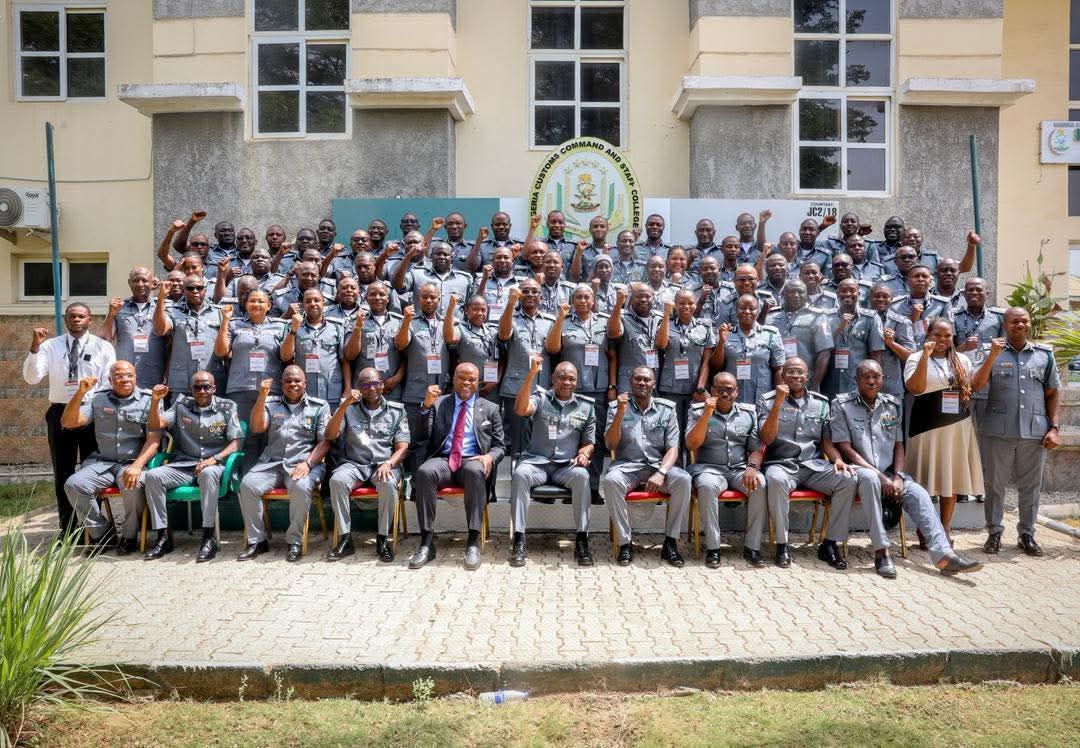
The Nigeria Customs Service (NCS) has reaffirmed its commitment to leadership development with the commencement of a strategic training programme for senior officers at the Nigeria Customs Command and Staff College, Gwagwalada.
The programme, titled Senior Customs Command and Leadership Course (Batch A), began on Monday, February 3, 2026, and is designed to prepare officers for higher responsibilities amid evolving operational, security and trade facilitation challenges.
Read also: ‘You Don’t Need to Go to Court for Every Matter’- Minister
Speaking during the session, the Comptroller-General of Customs (CGC), Adewale Adeniyi, described the course as a critical investment in the future of the Service, stressing that effective leadership is required at every level of the NCS.
Adeniyi warned against the gradual erosion of institutional values, standards and accountability as senior officers exit the system, noting that the sustainability of the Service depends on the quality of leaders being groomed today.
According to him, the leadership course is structured to test participants’ character, competence and discipline, adding that leadership naturally reveals both strengths and weaknesses.
“At this level, your success is determined less by what you know and more by who you are,”
“The authority you wield amplifies character. It exposes strength, but it also reveals weakness. This course is designed to make you reflect on your judgment, discipline, values and behaviour under pressure. That discomfort is deliberate, because growth does not occur in comfort zones.”
Read also: Adamawa in Mourning as 2nd Fufore LG Chairman Dies in 18 Months
He cautioned officers against personalising authority, hoarding knowledge or engaging in unhealthy competition, emphasising that strong institutions are built on shared purpose, continuity and mentorship.
The CGC explained that the programme represents a defining moment in the Service’s leadership transition, noting that future success would depend on the mindset, discipline and decisions of officers currently undergoing training.
The course features intensive sessions on key leadership competencies, including authenticity and integrity, emotional intelligence, effective communication, strategic thinking, business acumen and stakeholder management.
Participants also explored leadership lessons drawn from the 4×100-metre relay race, highlighting the importance of teamwork, synergy, timing and collective responsibility.
Discussions further examined how failures in teamwork can lead to hostile and unproductive work environments, while identifying the core attributes of high-performing teams such as shared mindset, mission, methods, movement, message and leadership by example.
Read also: Kebbi Sets Aside ₦100m for Residents Displaced by Bandits
Adeniyi urged participants to justify the Service’s investment in their development by translating knowledge into measurable results, building capable teams and mentoring future leaders within the NCS.
He congratulated the officers on attaining a major career milestone and encouraged them to fully engage with the programme, reflect honestly on the lessons learned and apply them in advancing the Service.